
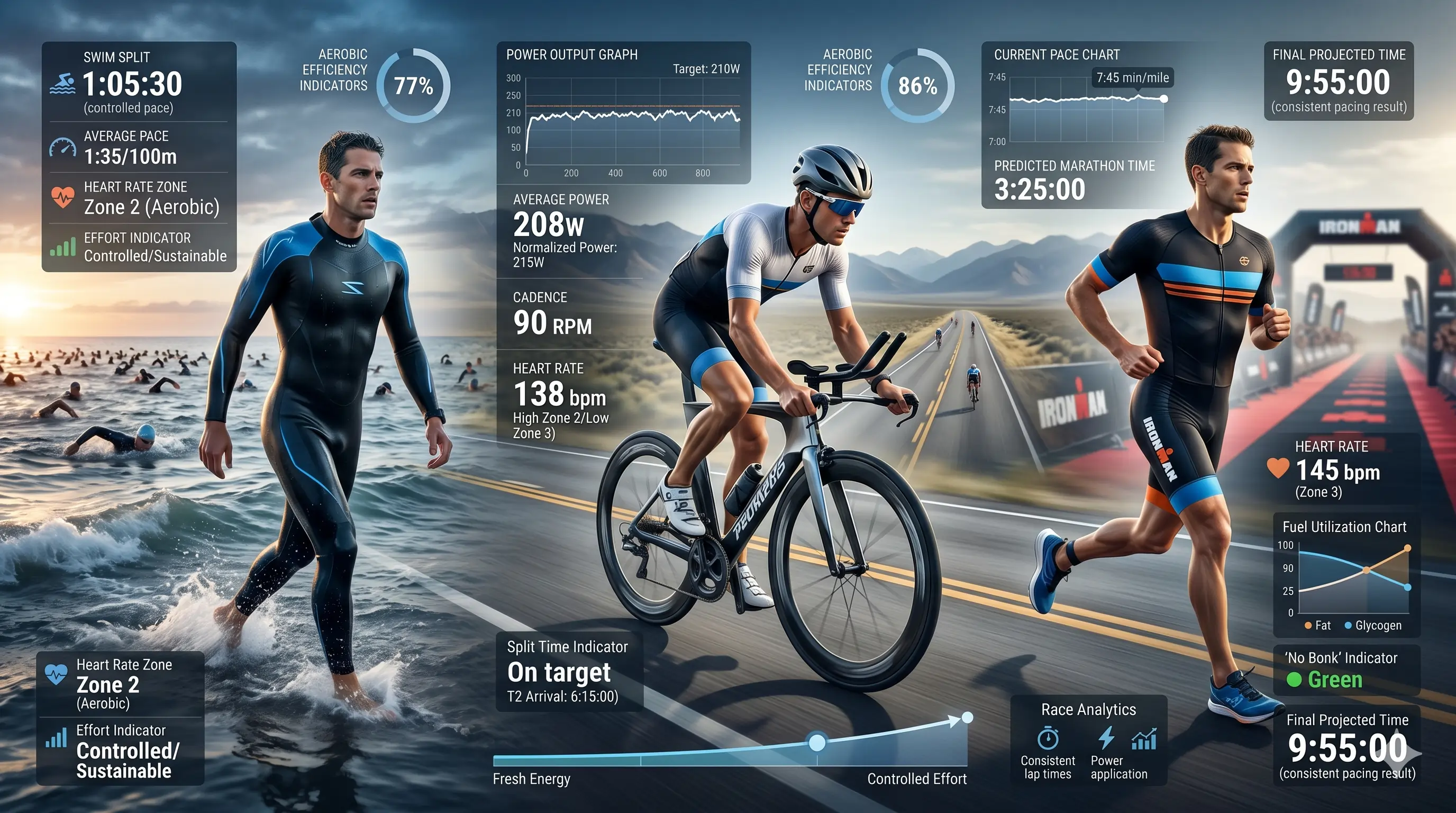
An Ironman pacing strategy is the foundation of a successful 140.6-mile race. Most endurance coaches agree that standardizing your effort long before you step onto the starting line is the key to finishing strong. Many athletes train their hearts out for months but struggle on race day simply because they pushed too hard early on. This guide will show you exactly how to manage your energy, nutrition, and pacing across the swim, bike, and run so you can reach the finish line feeling strong.
Success in a full-distance triathlon is less about how fast you can push in any single leg, and entirely about how well you save your energy for the final marathon. Having a clear, calculated plan prevents the dreaded "Ironman Shuffle" and ensures you finish with a smile. Simply put: Ironman pacing is the art of strategic energy budgeting—allocating your limited fuel and stamina so you don't run dry when you need it most.
The best pacing plan is to keep your swim at a relaxed Zone 2 effort (where you can easily breathe), keep your bike at a steady 65% to 72% of your threshold power (FTP), and run the first half of the marathon 15 to 20 seconds per mile slower than your target race pace. Pair this with 60 to 90 grams of carbs and 500 to 1,000 milligrams of sodium per hour to keep your engine running smoothly.
Ironman Pacing in One Sentence (The Golden Rule)
If you are new to the distance, here is a simple pacing rule: Swim easy, bike controlled, and run conservatively. If you cannot comfortably breathe or speak during the swim and bike, you are going too fast and burning the exact energy you need to survive the marathon.
Ironman Pacing Strategies by Discipline (Quick Navigation Hub)
To master the 140.6, you must understand that each leg requires a completely different approach. Jump to your specific area of focus to plan your targets:
- Ironman Swim Pacing Tips
Drafting, keeping your heart rate down, and saving your arms. - Ironman Bike Pacing Plan
Power targets, how to use watts, and avoiding overbiking. - How to Pace the Ironman Marathon
The 10/10/6.2 rule, managing cardiac drift, and walking aid stations. - Ironman Nutrition Strategy During Race
Fueling the engine, staying hydrated, and preventing stomach issues.
Ideal Ironman bike IF
The Ideal Ironman bike IF is a steady Intensity Factor (IF) of 0.65 to 0.72 of your Functional Threshold Power (FTP). Beginners should target 0.60–0.65, intermediate athletes 0.65–0.70, and competitive age groupers 0.70–0.75 to save leg strength for the run.
What causes Ironman bonk in one sentence
The primary answer to what causes Ironman bonk in one sentence is severe muscle energy depletion, driven by pushing too hard on the bike (above 75% FTP) and failing to eat 60 to 90 grams of carbs hourly.
Best pacing strategy for beginners
The best pacing strategy for beginners is to stay in Zone 2: swim at a controlled 0.60 to 0.65 FTP, and run-walk the marathon with structured breaks at every aid station.
Complete Ironman Pacing Strategy Breakdown by Goal
Race data shows that there is no single plan that works for everyone. Depending on your fitness, experience, and race goals, your target effort zones will look quite different. We have structured these pacing plans to align with your exact goals:
1. Ironman Pacing Plan Beginner (Survival & Finish)
If your main goal is to cross the finish line without walking the entire marathon, the name of the game is saving every bit of energy you can. Pushing too hard in the first few hours is the single greatest cause of first-timer DNFs.
- The Swim (2.4 mi): Focus entirely on swimming at a relaxed, comfortable pace. Do not try to keep up with fast swimmers; focus on long, smooth strokes and easy breathing. Seed yourself near the back of your age group. Check our triathlon swim drills to build visual sighting efficiency without spiking your heart rate.
- The Bike (112 mi): Keep your effort at a controlled 60% to 65% of FTP. Keep your cadence high (80-90 RPM). If your legs feel heavy on hills, shift to your easiest gear immediately. Use our nutrition guide to consume a minimum of 60g of carbs hourly.
- The Run (26.2 mi): Use a run-walk strategy from the very first mile. Run for 9 minutes, walk for 1 minute, and walk the entire length of every aid station to stay on top of your fluids and food.
2. Advanced Pacing Plan (PR & Kona Target)
For experienced athletes, pacing is about riding right at the edge of your aerobic limit without crossing into the red zone. Elite age-group competitors manage their numbers with incredible discipline.
- The Swim (2.4 mi): Focus on active drafting. Find a competitor who is slightly faster than you and stay on their hips or toes. This saves upper-body energy while keeping you moving at a great pace.
- The Bike (112 mi): Target a steady 70% to 75% of FTP. Keep your power smooth and avoid surging on climbs. If your FTP is 300W, your target is 210-225W. Track your numbers closely using our FTP explained guide.
- The Run (26.2 mi): Settle immediately into your target marathon pace plus 5 seconds for the first 5 miles, then target even splits. Walk aid stations only if it is part of your planned hydration strategy.
3. Sub-12 Hour Pacing Plan (The Age-Group Benchmark)
To break 12 hours, you need a disciplined balance of steady speed and efficient transitions. Age-groupers often lose up to 15 minutes simply standing still in T1 and T2.
- Target Splits: Aim for a 1:20 swim, a 6:00 bike (around 18.7 mph), a 4:20 marathon (9:55/mile), and 10 minutes total for transitions.
- Bike Strategy: Keep your effort to a controlled 65% to 68% of FTP. Biking 10 minutes faster by pushing harder will burn a massive amount of extra calories, which will cost you 45 minutes of walking later on. Refer to our training plans to model these target split distributions.
- Run Strategy: Keep your heart rate firmly in Zone 2. Settle into a rhythm of 9:30/mile for the first half, allowing cardiac drift to naturally bring you to 10:15/mile in the final miles.
4. Survival Pacing Plan (The Cutoff Strategy)
For athletes battling the 17-hour cutoff, pacing is a battle against sheer muscle fatigue and stomach issues. Keeping your joints moving and your stomach happy is your number one priority.
- Maximum Cutoff Limits: The swim cutoff is 2 hours and 20 minutes; the bike cutoff is 10 hours and 30 minutes from your start; the final race cutoff is 17 hours.
- Strategy: Swim a controlled 2:00 water leg. Bike conservatively at a 55%–60% effort to finish the bike leg in 7:30 to 8:00 hours. This leaves you a full 6.5 to 7 hours to walk or jog the marathon (around 15:00 to 16:00 per mile). Walk all uphills and drink electrolyte beverages to manage hydration.
Ironman Pacing Zones & Crucial Comparisons
Making the wrong pacing decisions early in a 140.6-mile race has major consequences later in the day. Review these simple performance comparisons to help you choose the best strategy for your goals:
1. Heart Rate vs. Power vs. Pace Comparison
| Metric | Best Used For | Pros vs. Cons | Sensory Rating |
|---|---|---|---|
| Heart Rate (HR) | Swim, Marathon (First Half) | Pro: Shows how hard your heart is actually working. Con: Can be slow to react and rises as you get hot or tired. |
Good (Internal Stress) |
| Power (Watts) | The Entire Bike Leg | Pro: Instant, exact effort regardless of wind or hills. Con: Requires power meters and testing in training. |
Excellent (Objective Input) |
| Pace (Min/Mile) | Marathon (Second Half) | Pro: Simple to track and match to your finish goals. Con: Dangerous to force if it is very hot or hilly. |
Moderate (Lagging Output) |
2. Zone 2 vs. Zone 3 Pacing Risk Comparison
Sustained pacing in Zone 3 (Tempo) feels totally fine in training, but during a full 140.6, it burns through your muscle glycogen reserves far too quickly. Look at the physiological differences side-by-side:
| Physiological Metric | Zone 2 (Aerobic Ceiling) | Zone 3 (Aerobic Tempo) | Pacing Risk Level |
|---|---|---|---|
| Primary Fuel Source | Fat Oxidation (Conserves Glycogen) | Carbohydrate Oxidation (Fast Burn) | Extreme Glycogen Shift |
| Lactate Accumulation | Very Low (Body easily clears it) | Gradual Build-up (Tires muscles over time) | Moderate-High Muscle Load |
| Heart Rate Over Time | Stable (Stays low and steady) | Spikes quickly (rises as you get tired) | Critical DNF Risk |
3. Hydration High vs. Low Sodium Strategy Comparison
Pacing is useless if you get dehydrated. If you don't replace the salt you lose in your sweat, your stomach won't absorb fluids properly, leading to sloshing and severe muscle cramps. Here is how the two strategies compare:
| Hydration Factor | High Sodium Strategy (Targeted) | Low Sodium Strategy (Default) | Gastrointestinal Impact |
|---|---|---|---|
| Sodium Intake (Per Hour) | 700mg to 1,200mg | < 300mg (Plain water or light mix) | Fluid absorption rate ceiling |
| Fluid Retention | Perfect balance (prevents bloating) | Dilutes blood (leads to sloshing) | Muscle cramping and brain fog |
| Stomach Comfort | Great (fluids absorb cleanly) | Poor (water sits unabsorbed) | Nausea and GI Distress |
4. Aggressive vs. Conservative Race Plan Comparison
Taking big risks early on might seem tempting if you are chasing a personal record, but a conservative approach is mathematically proven to deliver a faster total finish time. Look at the breakdown:
| Race Component | Aggressive Race Plan (Risk-Heavy) | Conservative Race Plan (Calculated) | Cumulative Delta |
|---|---|---|---|
| Swim Strategy | Hard start to draft top pack (High HR) | Smooth warmup, steady bilateral breathing | Conserves key arm glycogen |
| Bike Intensity Target | Pushing hard on climbs (IF > 0.75) | Steady power capped on climbs (IF 0.65-0.70) | Saves 400+ glycogen calories |
| Marathon Execution | Forcing target pace early ("banking time") | Even splitting, target pace +20s early on | Prevents late-race shuffle |
5. Fast Bike vs. Strong Run Tradeoff Comparison
The golden rule of Ironman racing is that every minute gained on the bike by over-riding costs you multiple minutes on the run. Here is how that math actually works out on race day:
| Bike Intensity (IF) | Bike Split Gain | Marathon Split Loss | Total Finish Time Impact |
|---|---|---|---|
| Aggressive (0.76 - 0.78 IF) | Gains 6 to 8 minutes | Loses 35 to 50 minutes (walking aid stations) | Net Loss: 27 to 42 minutes |
| Optimized (0.68 - 0.72 IF) | Baseline reference split | Optimal split execution (no walking needed) | Net Gain: Fastest Cumulative Time |
| Conservative (0.60 - 0.65 IF) | Loses 8 to 12 minutes | Highly reliable run split (near open PR) | Net Gain: Highly reliable finish |
Ironman Swim Pacing Tips & Strategy
The 2.4-mile swim is simply a tactical warmup. Your main goal here is to exit the water feeling relaxed, not exhausted. In other words: the swim sets the stage for the rest of your race day.
Before The Start & First 500 Meters
Seed yourself honestly. It is totally normal for your heart rate to spike due to adrenaline and the splash of the crowd. Do not fight the water. Focus on long, smooth strokes and establishing an easy, rhythmic breathing pattern.
Drafting Strategy
Drafting on the hips or toes of a swimmer who is slightly faster than you can save you up to 20% of your energy. That is essentially free speed. If you find good feet, stay on them. Make sure to check our triathlon training plans for swimming drills designed to practice this drafting skill.
Panic attacks happen when you push too hard too early, spiked by cold water shock. Start near the back, swim breaststroke for a minute if you need a breather, and let your heart rate settle.
Ironman Bike Watts Targets (Pacing Strategy)
Because riding even 5–10 watts above your target power can increase carbohydrate cost and muscular fatigue. Saving a few minutes on the bike often costs much more on the run.
Ideal Ironman Bike Watts Targets By Level
Most experienced coaches agree that your cycling split is an exercise in extreme patience. The table below represents standard bike intensity limits based on race observations:
| Athlete Level | Estimated Bike Time | Target IF Range |
|---|---|---|
| Beginner / First-Timer | 6.5 to 8 Hours | 0.60 - 0.65 |
| Intermediate | 5.5 to 6.5 Hours | 0.65 - 0.70 |
| Competitive Age Grouper | Under 5.5 Hours | 0.70 - 0.75 |
Managing Power Variations
Keep your power smooth and steady. Surging up hills burns matches that you can never get back. Cap your power on climbs to no more than 110% of your threshold power (FTP). If you don't know your FTP, read our FTP explained for triathletes guide. If you are serious about improving, check out our academy training guides.
Ironman Marathon Pacing Chart & Strategy
The marathon "wall" is purely muscle energy depletion. To avoid it, you must eat 60-90g of carbs hourly on the bike, cycle under 75% of your FTP, and run the first 10 miles of the marathon 20 seconds slower than your target pace.
The 10 / 10 / 6.2 Marathon Pacing Rule
- Miles 1-10 (The Trap): Your legs will feel deceptively fresh off the bike. Do not trust this feeling. Force yourself to run 15-20 seconds slower than your Ironman pace calculator target. Refer to our comprehensive marathon pacing guide to model these early splits.
- Miles 10-20 (The Grind): This is where you settle into your true target pace. Focus on a quick, light stride to reduce the impact on your legs. Walk the aid stations to ensure you are drinking enough fluids.
- Miles 20-26.2 (The Crucible): If you paced correctly, you will be passing hundreds of athletes who are walking. Rely on mental grit, flat cola, and water to get you to the red carpet.
Ironman Nutrition Strategy During Race
Pacing and nutrition are linked at the hip. If you push too hard, blood digests food poorly, leading to a sloshing stomach and nausea. If you don't eat enough, you will run out of fuel. For a deeper dive into this, check out our dedicated nutrition guide.
| Nutrient | Target Per Hour | Notes |
|---|---|---|
| Carbohydrates | 60 - 90 grams | Mix simple sugars for optimal absorption and stomach comfort. |
| Fluids | 700ml - 1.2 Liters | Adjust heavily based on heat and how much you sweat. |
| Sodium | 500mg - 1000mg | Critical for preventing cramps and keeping fluids absorbed. |
Ironman Race Strategy Checklist (Complete Race Day Plan)
Use this simple timeline to keep your pacing on track from sunrise to the finish line:
-
☐
T-Minus 2 Hours: Eat a familiar, carb-rich breakfast. Avoid high fats and fiber. Hydrate slowly.
-
☐
Swim Start: Seed yourself where you belong. Focus on long strokes and bilateral breathing.
-
☐
Bike Miles 0-10: Force an easy effort to let your swim heart rate settle down. Do not chase other riders.
-
☐
Bike Miles 10-100: Settle into your target power. Eat every 20 minutes and drink at least one bottle per hour.
-
☐
Bike Miles 100-112: Spin a slightly faster leg cadence (90+ RPM) to flush your muscles for the run.
-
☐
Run Miles 0-6: Run strictly 20 seconds slower per mile than target pace. Eat a carb gel and sip water at every single aid station.
-
☐
Run Miles 6-20: Hold a steady, comfortable pace. Walk the duration of every aid station to ingest calories cleanly.
-
☐
Run Miles 20-26.2: Dig deep, switch to caffeine/cola if stomach allows, and maintain high running cadence.
How to Calculate Your Target Ironman Splits
Creating a realistic triathlon pacing strategy requires data. Rather than guessing, you should calculate testable split targets based on your training. Doing this manually is prone to errors.
Calculate Your Target Ironman Splits
An Ironman Pace Calculator takes the guesswork out of race day. By inputting your target speeds, paces, and transition times, it instantly generates your total finish time and allows you to model different scenarios.
Open the Ironman Pace CalculatorFrequently Asked Questions
How hard should I bike during an Ironman?
You should bike at an Intensity Factor (IF) of 0.65 to 0.75, which corresponds to 65-75% of your Functional Threshold Power (FTP). Your perceived exertion should feel like a steady, all-day effort.
Should I walk during the Ironman marathon?
Yes. Walking the aid stations ensures you actually consume the required fluids and calories without spilling them. It also provides a brief heart rate reset that helps delay muscular fatigue in the late stages of the run.
Can I negative split an Ironman?
While negative splitting (running the second half faster than the first) is extremely rare in a full Ironman, aiming to run even splits is the hallmark of a perfectly executed race strategy. Even splits indicate perfect energy management.
What is a good first Ironman finish time?
For a first-time Ironman athlete, simply finishing before the 17-hour cutoff is a massive achievement. The average age-group finish time globally hovers around 12 hours and 30 minutes. Focus on finishing strong rather than chasing a specific clock time.
How many calories do you burn in an Ironman?
The average athlete burns between 7,000 and 10,000 calories during a full Ironman. This massive burn requires a highly disciplined nutrition pacing strategy on the bike to avoid total muscle glycogen depletion.
What is a good Ironman bike speed?
A good bike speed is entirely relative to wind, course elevation, and your target Intensity Factor. For most age groupers, a speed between 16 mph and 20 mph is standard, but you should pace strictly by power or heart rate rather than absolute speed.
How do I train pacing for an Ironman?
The best way to train is through progressive brick workouts (e.g., a 5-hour Zone 2 bike ride immediately followed by a 45-minute transition run). This teaches your legs how to run efficiently off the bike while testing your stomach under load.
What is cardiac drift in an Ironman?
Cardiac drift is a gradual rise in heart rate that occurs during prolonged exercise, even if your absolute power or pace remains constant. It is caused by dehydration, heat, and rising core body temperature. When cardiac drift occurs, you should slow down to maintain your aerobic ceiling.
Can you walk the entire Ironman marathon?
Yes. You can walk the entire 26.2-mile marathon and still finish the race under the 17-hour cutoff, provided you finish the swim and bike legs efficiently. Walking at a brisk 15-minute mile pace will complete the marathon in roughly 6.5 hours.
What is the hardest part of Ironman pacing?
The hardest part is the extreme psychological discipline required during the first 40 miles of the bike. Adrenaline and fresh legs make a target IF of 0.65 feel frustratingly easy, prompting athletes to push too hard early and inevitably trigger a major bonk later.
How much slower is an Ironman marathon vs. a normal marathon?
On average, an athlete's Ironman marathon split is 30 to 45 minutes slower than their standalone open marathon time. If your open marathon PR is 3:30, a perfectly executed Ironman run split would be between 4:00 and 4:15.
What heart rate is too high for an Ironman?
Any heart rate that exceeds your Zone 2 aerobic ceiling (typically above 75-80% of your maximum heart rate) for more than 5 consecutive minutes is too high. Sustained efforts in Zone 3 or Zone 4 accelerate glycogen depletion rapidly.
Can beginners finish an Ironman without a power meter?
Yes. While a power meter is highly recommended for objective tracking, beginners can easily execute a successful race by using a heart rate monitor locked in Zone 2, combined with a strict Rate of Perceived Exertion (RPE) cap of 5 out of 10.
Final thoughts
An Ironman is a long, rewarding test of patience and staying locked into a smart plan. Keep your effort under control, stay on top of your water and food, and trust your pacing numbers over your excitement early in the day.