
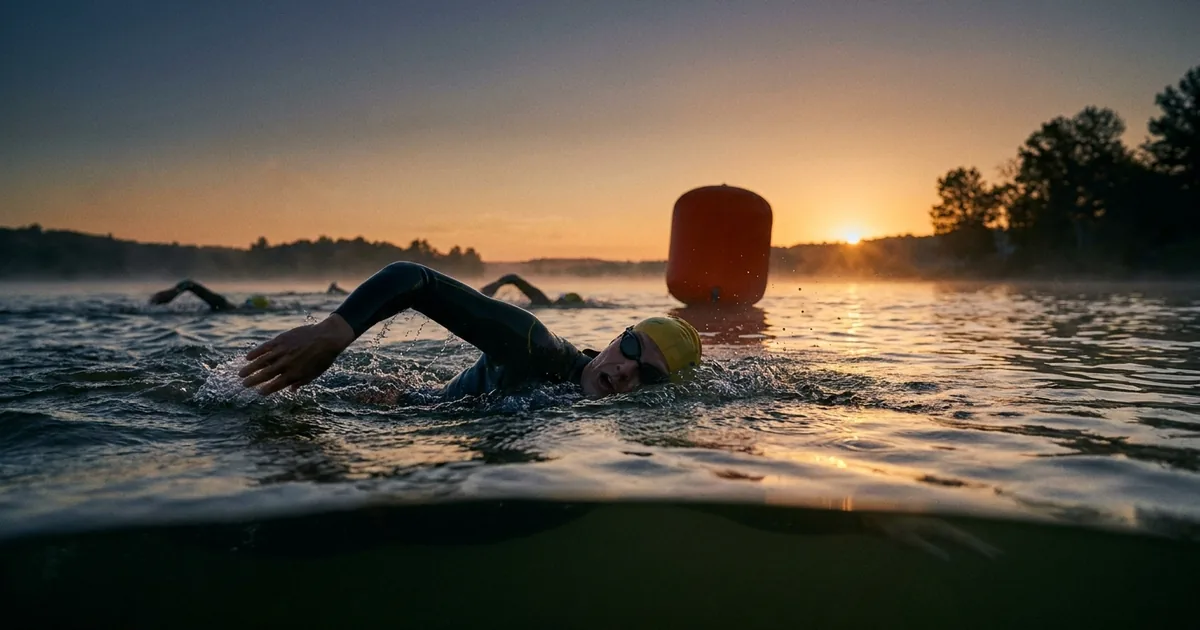
Pool pace is a useful starting point, but open-water swim pace is not a direct copy of your best repeat in the lane. No wall push-offs, sighting, contact, chop, current, wetsuit fit, and navigation can all move your triathlon swim split.
Start with a repeatable pool pace, then add 5 to 15 seconds per 100 m for open-water conditions unless you have race data that proves otherwise. Use the pace-to-split converter to convert that adjusted swim pace into a race split.
Use repeatable pace, not best pace
Your best single 100 m is rarely a good race input. A better number is the pace you can repeat calmly across a longer set while maintaining form. For example, if you can repeat 10 x 100 m at 2:00 with short rest, that is more useful than one 1:43 effort.
Why open water is slower for many athletes
Open water removes the wall push-off and adds navigation. Every sighting motion can interrupt body position. Contact at the start can raise heart rate. Choppy water can shorten the stroke. These small costs add up across 750 m, 1.5 km, 1.9 km, or 3.8 km.
When open water can be faster
A wetsuit, legal drafting, current, and strong course navigation can make open-water pace faster than expected. Experienced swimmers sometimes gain time from better body position and drafting. Newer swimmers should still plan conservatively until race data supports a faster estimate.
Simple adjustment guide
- Experienced open-water swimmer: pool pace plus 0-5 sec/100 m.
- Average age-grouper: pool pace plus 5-10 sec/100 m.
- New or anxious swimmer: pool pace plus 10-20 sec/100 m.
How to validate the estimate
Use one open-water practice or race rehearsal to check the adjustment. Swim 400 to 800 m at calm effort, record the pace, then compare it with your pool input. If the open-water result is much slower, look for the cause before changing the calculator: sighting too often, drifting off line, starting too hard, poor breathing rhythm, or anxiety in contact.
For longer races, build a small swim buffer even if the pool numbers look strong. A relaxed swim that is two minutes slower can still be faster for the whole race if it leaves you calm enough to ride steadily and start fueling early.
The fastest overall race rarely comes from forcing the swim. A calm swim sets up a cleaner T1, a steadier bike, and a run that begins with less stress already in the system.
Why pool pace does not transfer
Almost every triathlete overestimates their swim, and the reason is structural rather than psychological. A pool gives you a black line to follow, a wall to push off every twenty-five metres, flat water, a constant temperature, lane discipline, and a clock in your eyeline. Open water removes all of it at once.
The push-off alone is worth more than most athletes realise. In a fifty-metre pool you get a free glide roughly every twenty-five seconds, and in a twenty-five metre pool twice as often. Over 1,900 metres those accumulate into a meaningful chunk of time that simply does not exist in a lake.
Add sighting, which interrupts your stroke and raises your head and hips out of an efficient line, and the realistic expectation for most age-group athletes is that open-water pace sits somewhere between five and fifteen percent slower than pool pace for the same effort.
Sighting: the skill that costs the most time
Poor sighting costs time in two separate ways, and the second is much larger than the first. The direct cost is the stroke disruption - lifting your head drops your legs, breaks your rhythm, and adds drag. The indirect cost is swimming further than the course requires.
A two-degree navigational error over 1,900 metres adds around seventy metres. A larger drift, which is entirely normal for athletes who sight every twenty strokes in choppy water, can add several hundred. It is genuinely common for age-groupers to record 2,100 to 2,300 metres on a 1,900 metre course.
The fix is to sight more often than feels necessary - every six to ten strokes in open water - using an efficient technique: lift only the eyes above the surface, ideally as part of the breathing stroke, and pick a large fixed landmark behind the buoy rather than the buoy itself, which disappears in chop.
What a wetsuit is actually worth
A wetsuit provides buoyancy, which raises your legs and reduces drag, and it provides warmth, which preserves the ability to produce power. For most athletes the benefit lands somewhere between three and eight percent, with the largest gains going to swimmers whose legs sink - typically adult-onset swimmers and those with more muscle mass.
The gain is not automatic. A poorly fitted suit that restricts your shoulders can cost more than the buoyancy returns, and a suit that is too tight at the neck causes the panic that ruins swims. Practise in it at least three or four times before racing, including at least one hard effort, and get the shoulder mobility right before worrying about thickness.
Wetsuit legality depends on water temperature and is decided on race morning, not by you. Every swim plan should have a non-wetsuit version.
Drafting: the biggest free gain in triathlon
Unlike the bike leg, drafting is entirely legal in the swim, and it is the single largest efficiency gain available. Swimming directly behind someone can reduce drag substantially, and sitting on a hip - level with their waist, slightly to one side - is generally both effective and less likely to result in touched feet.
The catch is that drafting requires picking the right person. Attaching yourself to someone meaningfully faster leaves you anaerobic within two hundred metres; someone slower costs you the time you were trying to save. Spend the first few hundred metres finding feet that are moving at a pace which feels sustainable, then hold them and let them sight for you.
Starting: the two hundred metres that decide the swim
More triathlon swims are ruined in the first two minutes than in the remaining forty. A hard start in cold water triggers a well-documented response - rapid breathing, elevated heart rate, a sense of not being able to get air - which athletes then interpret as panic.
The countermeasures are straightforward and reliable. Warm up in the water beforehand if permitted, even briefly, so the cold-shock response happens before the gun rather than after it. Start deliberately controlled for the first two hundred metres, breathing to a rhythm you have practised. Position yourself according to your honest ability rather than your ambition, and if the feeling arrives anyway, roll onto your back for a few seconds and let the breathing settle. Ten seconds spent recovering costs far less than the two minutes lost to a swim spent in distress.
Estimating your own open-water pace
The only genuinely reliable method is measurement: swim your race distance in open water, in the kit you will race in, and record the actual time and the actual distance covered. Do it twice.
Failing that, take your pool pace for the race distance, add five to fifteen percent depending on your sighting confidence and the likely conditions, subtract a wetsuit benefit if the swim is likely to be wetsuit-legal, and then plan against the slower end of that range rather than the middle. Enter that figure into the split calculator and remember that the swim is ten to fifteen percent of your day - the aim is to leave the water calm and on plan, not to save two minutes you will spend twice over on the bike.
Pacing the swim by breathing, not by watch
Almost nobody can read a watch usefully mid-swim, and stroke rate is a poor proxy for effort because it rises as technique degrades. The reliable pacing instrument in open water is your breathing pattern.
Pick a pattern in training - bilateral every three strokes is common, every two on the harder side for some athletes - and treat holding it as the definition of correct effort. If you cannot maintain your practised pattern, you are swimming too hard, and the answer is to ease immediately rather than to hope it settles.
This works because breathing rhythm is directly coupled to effort and is available to you continuously, without turning your head to a device or doing arithmetic while being swum over. It also gives you something concrete to do when the start is chaotic: return to the pattern.
Water temperature and what it does to your plan
Cold water does two separate things, and athletes usually plan for only one. The obvious effect is the cold-shock response in the first minutes - rapid involuntary breathing, elevated heart rate, and a strong sense of being unable to get air. It passes within a couple of minutes and is not dangerous in itself for a healthy swimmer, but it feels alarming enough to cause real panic.
The less obvious effect is on your hands and forearms. Cold reduces sensation and grip strength, so your catch degrades and your pace drops even though effort feels unchanged. Athletes swimming meaningfully slower than expected in cold water often assume they are unfit; usually they simply cannot feel the water.
Both are mitigated the same way: get in beforehand if permitted, even for thirty seconds, so the shock response happens before the gun. Splash water into your suit and on your face. Then start controlled and accept that the first few hundred metres will be slower than your average.
Where to position yourself on the start line
Start position is a genuine tactical decision and most age-groupers get it wrong by optimism. Seeding yourself faster than you are means being swum over repeatedly, which costs far more than the few seconds of clear water you hoped for.
The honest questions are how comfortable you are with contact and how confident your sighting is. Nervous or contact-averse swimmers should start wide and slightly back, where the water is cleaner and the cost is only a handful of seconds. Confident swimmers who can hold feet benefit from starting closer to the front and inside, where the draft is.
Rolling and wave starts change this considerably - with a rolling start you largely choose your own traffic by choosing when to enter, and the crush is much reduced. Check the format in the athlete guide, because it changes the right answer.
Practising the things that actually go wrong
Pool fitness transfers poorly because pool sessions rehearse none of the failure modes. A short list of things worth deliberately practising, ideally in open water:
- Sighting under fatigue. Easy when fresh, sloppy when tired, and it is the tired version that determines how far you swim.
- Swimming with contact. Have a training partner swim close, brush your feet, and cross in front. The first time this happens should not be on race day.
- Losing goggles. Practise swimming fifty metres with them round your neck, and practise clearing and refitting them while treading water.
- Turning at a buoy. Congested, contact-heavy, and the place most people lose their rhythm. Approach slightly wide and accelerate out rather than in.
- Starting hard then settling. Race starts are always faster than plan. Rehearse the deliberate downshift after two hundred metres.
Putting a realistic swim number in the plan
The swim is only ten to fifteen percent of your day, which cuts both ways: it is not where races are won, but it is where they can be lost by arriving on the bike panicked, hypothermic, or already at threshold.
So the target for the swim leg is not a time, it is a state. Exit the water calm, breathing under control, and roughly on the plan you rehearsed. When you enter the number into the split calculator, use a measured open-water time rather than a pool conversion, and if you only have pool data, plan against the slower end of the adjustment range. A swim that comes in two minutes under plan changes almost nothing; a swim that wrecks the first hour of the bike changes everything.