
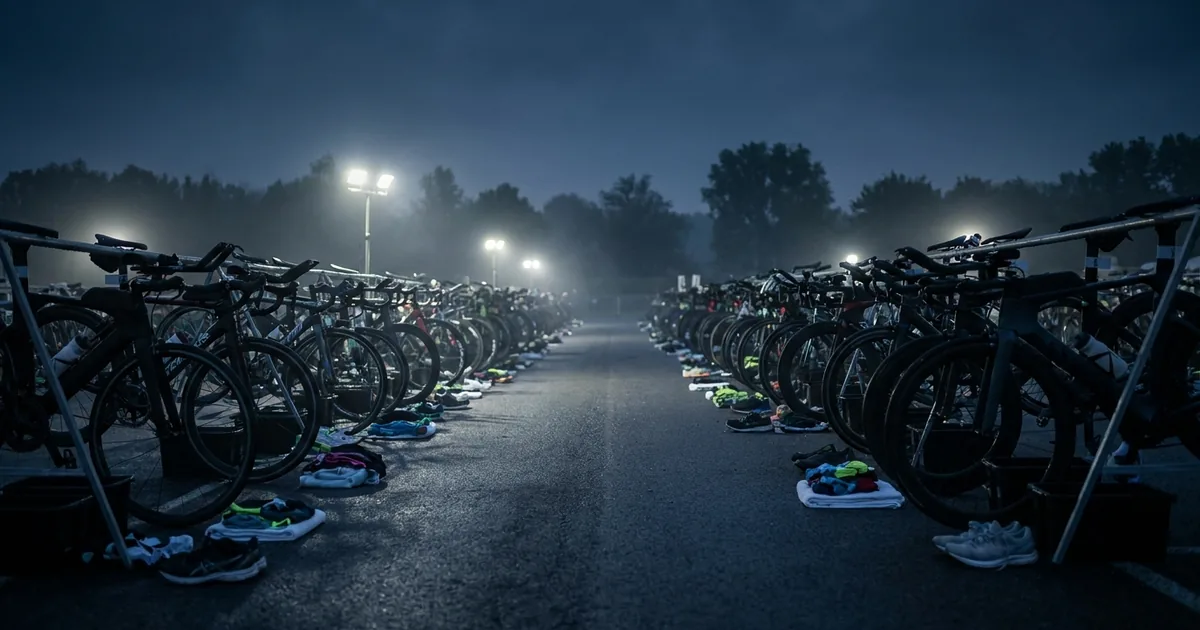
Most first-timers are not short of fitness. They are short of information. They have trained for months and still have no clear picture of what the morning actually looks like, which is why the nerves attach to logistics rather than to the racing. This is a walkthrough of the day from arrival to finish.
Arrive when transition opens, rack your bike, set your kit out in the order you will use it, get in the water before the start if you can, swim calmly, ride within yourself, and expect the first kilometre of the run to feel strange. Plan the splits in advance with the sprint triathlon calculator.
The week before
Read the athlete guide properly. Every race publishes one, most first-timers skim it, and almost every avoidable race-morning problem is answered in it: what time transition opens and closes, where to park, whether the swim is wetsuit-legal, what the course looks like, where the cutoffs are, and which bags go where.
Get the bike serviced about a week out rather than two days out, and ride it afterwards to confirm nothing was left loose. A week gives a shop time to order a part if they find a worn chain or a failing bearing; two days does not.
Then stop changing things. Race week is not when you try new shoes, a new saddle position, a different breakfast, or an unfamiliar gel. Every novelty is a variable that can only hurt you.
Race morning: arrival and registration
Aim to arrive when transition opens, not when it closes. The extra time costs you nothing and buys you the ability to deal with a flat tyre, a forgotten item, or a long queue without panic.
You will usually collect a timing chip, a race number for your bike and helmet, and sometimes body markings. Put the chip on immediately - around the ankle, under the wetsuit if you are wearing one - because a completed race with no chip is a race with no result.
Setting up transition
Find your rack position and note a fixed landmark you will still recognise when the bikes have gone: a tree, a marquee, a lamp post. Do not navigate by neighbouring bikes. They leave before you come back, and more time is lost to athletes who cannot find their spot than to any equipment choice.
Lay your kit out in the order you will use it, not by sport. A small bright towel marks your footprint and gives you somewhere clean to stand. Helmet upside down on the bars with sunglasses inside and straps open. Bike shoes below. Run shoes with elastic laces behind them. Race belt on top.
Two rules that catch people out: your helmet must be buckled before you take the bike off the rack and stay buckled until it is racked again, and your gear must stay within your own space. Both are enforced.
The swim start
This is the part people fear, and the fear is mostly about the first two minutes rather than the distance. Cold water triggers a well-documented response - fast shallow breathing, a raised heart rate, a sense of not being able to get enough air. It passes within a couple of minutes and it is not dangerous in a healthy swimmer, but it feels alarming if it arrives unannounced.
The countermeasure is simple: get in beforehand if the race allows it, even for thirty seconds, so the shock happens before the gun instead of after it. Splash water on your face and inside your suit.
Then start slower than you think you should. Position yourself according to your honest ability rather than your ambition - wide and slightly back if you are nervous about contact, which costs a handful of seconds and removes most of the washing-machine experience. Breathe to the rhythm you practised. If it goes wrong, roll onto your back for a few seconds and let it settle; ten seconds spent recovering costs far less than a swim spent in distress.
Many races now use a rolling start, where athletes enter a few at a time rather than in one mass. If yours does, the crush is much reduced and you largely choose your own traffic.
T1: swim to bike
Start unzipping and pulling the wetsuit down while you are running from the water, not standing at your rack. Push it to your knees on the way in, then stand on the fabric and pull each leg straight up and out - your bodyweight does the work rather than your grip.
Helmet on and buckled. Sunglasses. Race belt. Then run the bike to the mount line and get on past it, never before.
Expect this to feel chaotic the first time. It is supposed to. The athletes who look smooth are not moving faster, they are simply never stopping to decide what to do next.
The bike
The first ten minutes will feel strange because your heart rate is high from the swim and your legs have not been cycling. Ease into it rather than attacking, and let things settle before you look at any target.
Then ride within yourself. This is the single most consequential decision of the day and it is almost always made wrong in a first race. The bike is roughly 45% of your total time, it supports your bodyweight, and the effort is continuous - so riding too hard feels perfectly sustainable at the time. The bill arrives on the run.
Unless you are racing a draft-legal event, you must keep a legal gap to the rider in front, typically ten to twelve metres, and move through quickly when overtaking. Sitting behind someone is a penalty, not a tactic.
Eat and drink on the bike. It is the only leg where taking anything on is genuinely easy, and whatever the run needs has to go in here.
T2 and the run
Rack the bike, helmet off only after it is racked, shoes on, go. If you use elastic laces you simply step in.
The first few hundred metres of the run will feel wrong. Your legs are heavy, your cadence is short, and it feels as though you have forgotten how to run. This is normal, it happens to everyone, and it passes in five to ten minutes. The mistake is to panic and either force your normal pace or conclude that the day has fallen apart.
Run the first kilometre deliberately controlled and let the legs arrive. If you paced the bike sensibly, they will. You can model what pace to realistically expect with the run off the bike calculator, which is usually a good deal slower than your standalone pace.
The finish, and what nobody warns you about
You will feel cold surprisingly quickly once you stop, even on a warm day, so have a warm layer in your bag. Eat something. Drink something that is not just water.
Then go and collect your bike - transition usually does not reopen until the last competitor is off the course, which catches out people who planned to leave immediately.
Your first finish time is not a verdict on you. Nearly every athlete who now races well has a first-race time they would consider slow, and it is completely irrelevant to what they went on to do. The useful outcome of a first triathlon is knowing how the day works, which is exactly what makes the second one faster - typically by several minutes on identical fitness, purely from not fumbling.
A realistic first-race checklist
- Swim: goggles plus a spare pair, swim cap, wetsuit if legal, lubricant for neck and ankles.
- Bike: serviced bike, helmet, shoes, spare tube and a way to inflate it, one bottle.
- Run: shoes with elastic laces, race belt, hat if it is hot.
- Admin: timing chip, race numbers, athlete guide, a small towel, sunscreen.
- After: warm layer, dry socks, food.
Build the whole list for your specific race format with the race-day checklist, and put honest transition times into the finish time calculator rather than optimistic guesses - at sprint distance the transitions are a bigger share of your day than you would expect.