
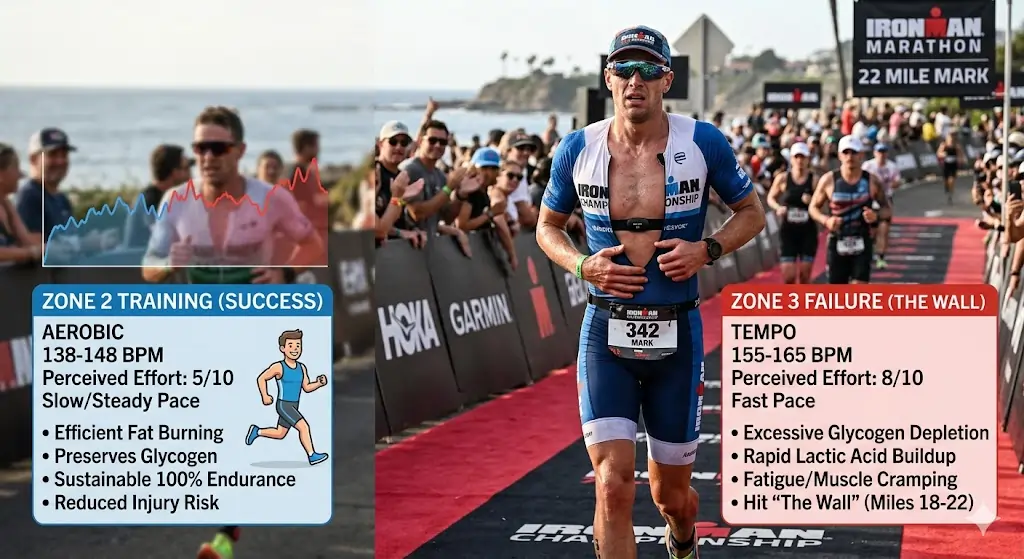
You've nailed the swim. You've held a disciplined bike split. You hit T2 with time to spare.
Then mile 6 of the marathon hits. Your legs turn to cement. Your pace drops. You're walking. You've "hit the wall."
Most athletes blame the run. But the truth is far more uncomfortable: your Ironman marathon didn't fail on race day. It failed in training.
Specifically, it failed because too much of your preparation happened in Zone 3—the deceptive "moderately hard" zone that feels productive but systematically sabotages marathon durability. Meanwhile, the physiological foundation that actually protects your run—Zone 2 aerobic development—was neglected.
This pillar guide breaks down the science of Zone 2 vs Zone 3 training, explains why the "gray zone" trap derails age-groupers, and gives you a step-by-step framework to build true Ironman marathon durability. Whether you're chasing a sub-10 PR or a strong first finish, understanding this training distribution is your fastest path to a stronger, more consistent run. In this paradigm, raw inputs like zone baselines are mere variables—the Tri Split Calculator serves as your master race execution system to model environmental and physiological shifts into a single, executable pacing plan.
Table of Contents
- 1. Zone 2 vs Zone 3: The Physiology Simplified
- 2. The "Gray Zone" Trap: Why Most Athletes Train Wrong
- 3. How Zone 3 Overtraining Sabotages Your Ironman Run
- 4. The Zone 2 Advantage: Building True Marathon Durability
- 5. The Science: Fat Oxidation, Mitochondria & Lactate Clearance
- 6. How to Train the Right Ratio (80/20 & Pyramidal Models)
- 7. Verifying Your Zones: Are You Actually in Zone 2?
- 8. Translating Training Zones to Race-Day Execution
- 9. Common Mistakes & How to Fix Them
- 10. Sample 12-Week Zone 2-Dominant Build
- 11. Frequently Asked Questions
- 12. Tools to Build Your Durability-Focused Race Plan
1. Zone 2 vs Zone 3: The Physiology Simplified
Before fixing your training, you must understand what each zone actually does to your body. Most athletes confuse them, which is exactly why they plateau.
Zone 2: The Aerobic Foundation
- Definition: 55-75% FTP | 60-70% HRmax | RPE 2-4/10
- Primary Fuel: Fat (~60-80%) + Carbohydrates
- Physiological Focus: Mitochondrial density, capillary development, fat oxidation efficiency, cardiac stroke volume
- Sustainability: Hours. This is your "all-day" pace.
Zone 3: The Tempo/Sweet Spot Zone
- Definition: 76-90% FTP | 70-80% HRmax | RPE 5-6/10
- Primary Fuel: Carbohydrates (~60-75%) + Fat
- Physiological Focus: Lactate threshold elevation, glycogen utilization, muscular endurance at higher intensities
- Sustainability: 1-3 hours max. Fatigue accumulates rapidly.
| Metric | Zone 2 | Zone 3 |
|---|---|---|
| Heart Rate | Steady, minimal drift | Gradual rise, faster fatigue |
| Breathing | Nasal or conversational | Mouth breathing, deeper |
| Recovery Cost | Low (next-day fresh) | Moderate-High (requires 24-48h) |
| Race Application | Ironman bike/run base pacing | 70.3 bike, short time trial efforts |
| Training Role | Builds the engine | Tunes the transmission |
👉 Key insight: Zone 2 teaches your body to endure. Zone 3 teaches your body to suffer. You can't tune a transmission that hasn't been built.
2. The "Gray Zone" Trap: Why Most Athletes Train Wrong
What Is the Gray Zone?
Zone 3 is often called the "gray zone" or "junk miles" because it sits in a physiological no-man's-land: too hard to maximize aerobic development, too easy to significantly raise VO₂ max or threshold. Yet it feels "productive" enough to justify the effort.
Why Age-Groupers Gravitate Here
- Ego & Group Dynamics: Group rides and run clubs naturally settle at Zone 3 pace. It's social, competitive, and feels "fast."
- Immediate Feedback: FTP and pace improve quickly in the short term, creating a false sense of progress.
- Misguided Training Advice: "Train at race pace" is misinterpreted as "spend most of your time in Zone 3."
- Time Constraints: Athletes think "harder = faster results," so they skip long easy sessions for shorter intense ones.
The Research Reality
Multiple studies on elite endurance athletes show a consistent 80/20 distribution: ~80% of training volume in Zone 1-2, ~20% in Zone 4-5, and <5% in Zone 3. Age-groupers, by contrast, spend 60-70% of training in Zone 3, with minimal true Zone 2 volume and sporadic high-intensity work. The result: chronic fatigue, plateaued FTP, poor fat adaptation, and inevitable marathon fade.
3. How Zone 3 Overtraining Sabotages Your Ironman Run
The Ironman marathon isn't won by who has the highest FTP. It's won by who has the best metabolic durability—the ability to run 26.2 miles off the bike without collapsing. Zone 3 overtraining systematically erodes this durability.
1. Glycogen Dependency → Early Bonking
Zone 3 relies heavily on carbohydrate metabolism. If 60-70% of your training happens here, your body becomes conditioned to burn glycogen as its primary fuel. On race day, when glycogen stores dip around mile 15-18, your metabolism lacks the flexibility to switch to fat efficiently. The result: sudden fatigue, heavy legs, positive split.
2. Impaired Mitochondrial Density → Slower Recovery Off the Bike
Mitochondria are your cellular power plants. Zone 2 training triggers PGC-1α signaling, which dramatically increases mitochondrial number and efficiency. Zone 3 does not. Fewer mitochondria = slower oxygen utilization = higher lactate accumulation at the same pace = compromised run form starting at T2.
3. Elevated Systemic Fatigue → Neuromuscular Breakdown
Zone 3 creates significant muscle microtrauma and central nervous system fatigue. When accumulated over months without adequate Zone 2 recovery, your neuromuscular system loses the ability to maintain running mechanics under load. Stride shortens. Ground contact time increases. Impact forces spike. Injury risk rises.
4. Poor Lactate Clearance Capacity → The "Heavy Leg" Phenomenon
Zone 2 actually improves your body's ability to clear lactate during higher-intensity efforts by increasing capillary density and lactate transporter proteins (MCT1/MCT4). Skipping Zone 2 means lactate accumulates faster during the bike, and your legs enter the run already acidic. You feel "heavy" not because you're unfit, but because your clearance pathways are underdeveloped.
👉 Translation: Zone 3 training makes you fast in short races. Zone 2 training makes you unbreakable in long ones.
4. The Zone 2 Advantage: Building True Marathon Durability
The Four Pillars of Zone 2 for Ironman Success
| Pillar | What It Builds | Race-Day Impact |
|---|---|---|
| Fat Oxidation (FatMax) | Teaches body to burn fat at higher intensities | Delays glycogen depletion; prevents mile-18 wall |
| Capillary Network Density | Increases oxygen delivery to working muscles | Lower HR at race pace; faster recovery between efforts |
| Mitochondrial Efficiency | Enhances ATP production per oxygen molecule | Sustains power/pace with less metabolic cost |
| Cardiac Stroke Volume | Increases blood pumped per heartbeat | Better thermoregulation; reduced cardiovascular drift |
The Durability Multiplier
Research shows athletes with high Zone 2 volume can maintain 85-90% of their fresh-state running economy after a 4-5 hour bike. Zone 3-dominant athletes typically drop to 65-75%. That 15-20% difference is often the gap between a 4:10 marathon and a 4:45 walk-run shuffle.
The Psychological Edge
Zone 2 training teaches patience, pacing discipline, and metabolic awareness. You learn to trust effort over pace, to breathe deeply, to let faster athletes pass, and to stay calm when the race gets hard. These mental adaptations are just as critical as physiological ones on the Ironman marathon course.
5. The Science: Fat Oxidation, Mitochondria & Lactate Clearance
FatMax: Teaching Your Body to Burn Fat at Race Pace
Every athlete has a FatMax intensity—the effort level where fat oxidation peaks. For most, it aligns closely with Zone 2. Training here shifts the crossover point upward, meaning you can run at 8:30/mile while burning primarily fat instead of carbs. This is the holy grail of Ironman nutrition: preserving glycogen for when you actually need it (late run, hills, surges).
PGC-1α & Mitochondrial Biogenesis
Zone 2 exercise activates the PGC-1α pathway, a master regulator of mitochondrial creation. Studies show 8-12 weeks of consistent Zone 2 training can increase mitochondrial density by 20-30%. More mitochondria = more aerobic power = less reliance on anaerobic metabolism = cleaner legs off the bike.
The Lactate Shuttle Paradox
Zone 3 produces lactate. Zone 2 clears it. By spending most of your time in Zone 2, you upregulate MCT1 transporters, which shuttle lactate out of working muscles and into the heart, brain, and slow-twitch fibers to be used as fuel. This means when you do hit Zone 3-4 efforts in training or racing, your body handles them more efficiently and recovers faster.
👉 Analogy: Zone 2 widens the highway. Zone 3 puts more cars on it. You can't handle race-day traffic on a two-lane road.
6. How to Train the Right Ratio (80/20 & Pyramidal Models)
| Model | Zone 1-2 | Zone 3 | Zone 4-5 | Best For |
|---|---|---|---|---|
| Polarized | 75-80% | 5-10% | 15-20% | Advanced athletes, high recovery capacity |
| Pyramidal | 70-75% | 15-20% | 10-15% | Age-groupers, time-constrained athletes |
Live Modeling: Zone 2-Dominant Pacing Chart Strategy
- 🚴 FTP Baseline: 220 Watts
- 🏃 Marathon PB (standalone): 3:45:00
- 🔥 Training Strategy: Zone 3 heavy (65% volume)
- 🚴 Ironman Bike NP: 165W (75% FTP)
- 📉 Bike TSS Accumulation: 310 TSS
- 🚶 Ironman Marathon Split: 4:58:00 (Walk-Run shuffle)
- 🚴 Ironman Bike NP: 150W (68% FTP)
- 📈 Bike TSS Accumulation: 245 TSS
- 🏃 Ironman Marathon Split: 4:08:00 (Strong steady run)
7. Verifying Your Zones: Are You Actually in Zone 2?
The #1 reason Zone 2 training fails: athletes train in Zone 3 thinking it's Zone 2. Here is how to verify.
The Talk Test (Gold Standard)
Zone 2: Can speak full sentences comfortably. Nasal breathing possible.
Zone 3: Short phrases only. Mouth breathing required.
Heart Rate Drift Test
- Ride/run 60 minutes at "Zone 2"
- If HR rises >5% without pace/power change, you're likely in Zone 3 or dehydrated/fatigued
- True Zone 2 shows <3% drift over 60 minutes
Power Correlation
Zone 2 should feel "boringly easy." If you're checking your watch frequently because it "feels slow," you're likely in the right zone. If you're struggling to hold conversation or feeling a "burn," dial it back 5-10 watts.
8. Translating Training Zones to Race-Day Execution
Zone 2 training teaches your nervous system to recognize true aerobic effort. On race day, this means you won't surge off the start line, you'll hold power even when pace slows on climbs, and you'll trust RPE over GPS pace.
| Training Focus | Race-Day Translation |
|---|---|
| High Zone 2 volume | Bike: Hold 70-80% FTP effortlessly for 5+ hours |
| FatMax optimization | Run: Burn fat at 9:00/mile; preserve glycogen for mile 20+ |
| Capillary/mitochondrial density | T2 Transition: Legs feel "springy," not heavy; faster neuromuscular reset |
| Lactate clearance upregulation | Late run: Maintain form despite fatigue; avoid positive split |
9. Common Mistakes & How to Fix Them
- ❌ Mistake #1: "Easy" Days Are Too Hard: Zone 2 rides run at 78% FTP instead of 65%.
👉 Fix: Drop power 10-15W. Trust the talk test. Accept slower pace. Volume > intensity in Z2. - ❌ Mistake #2: Skipping Long Zone 2 Sessions for Short Z3 Workouts: 3x1h Z3 sessions replace 1x3h Z2 ride.
👉 Fix: Prioritize duration. Z2 adaptations require 60-90+ minute exposures to trigger mitochondrial signaling. - ❌ Mistake #3: Group Training Mismatch: Riding with faster groups forces Z3/Z4 pace.
👉 Fix: Ride solo or at the back. Use power to hold Z2. Let the group go. Your race isn't theirs.
10. Sample 12-Week Zone 2-Dominant Build
Phase 1: Base Development (Weeks 1-4)
Focus: Aerobic volume, fat adaptation, technique. Zone Split: 80% Z1/Z2, 15% Z3, 5% Z4. Expected Feel: "Too easy" at first. Pace slower. HR stable. Recovery fast.
Phase 2: Integration (Weeks 5-8)
Focus: Introduce race-specific tempo, maintain Z2 volume. Zone Split: 75% Z1/Z2, 15% Z3, 10% Z4. Expected Feel: FTP rising. Z2 feels easier. Z3 efforts more sustainable.
Phase 3: Peak & Specificity (Weeks 9-12)
Focus: Race pacing rehearsal, durability testing, taper. Zone Split: 70% Z1/Z2, 20% Z3, 10% Z4. Expected Feel: Confident at race pace. Legs durable. Ready for 140.6.
11. Frequently Asked Questions
Q: How do I know if my zones are accurate?
A: Use the talk test, HR drift test, and RPE. If Zone 2 feels conversational, shows <5% HR drift over 60 min, and recovers quickly, it's accurate.
Q: Can I build Zone 2 aerobic base while also improving FTP?
A: Yes. Zone 2 training improves lactate clearance and mitochondrial efficiency, which often raises FTP indirectly. Add 1-2 Z4 sessions/week for direct threshold stimulus, but keep Z2 as 70-80% of volume.
Q: I only have 8 hours/week to train. Can I still do 80% Zone 2?
A: Absolutely. Use the pyramidal model: 6h Z1/Z2, 1h Z3, 1h Z4/Z5. Duration matters most in Z2.
12. Tools to Build Your Durability-Focused Race Plan
Understanding Zone 2 vs Zone 3 is step one. Executing a durable race plan is step two. Use the free TriSplitCalc tools to estimate race splits, FTP-based bike targets, run-off-bike pace, heat adjustment, cutoff buffer, and nutrition timing. The calculators do not replace a coach or auto-generate training-zone distributions; they help you make the race plan more explicit.
Start planning now: Visit https://trisplitcalc.com/ to build a free, transparent, power-aware Ironman planning estimate.
Disclaimer: This content is for educational purposes. Training distribution should be individualized based on fitness, experience, recovery capacity, and health status. Consult a certified triathlon coach, sports physician, or exercise physiologist before making significant changes to your training, especially if you have cardiovascular or metabolic conditions. © 2026 TriSplitCalc.com. All rights reserved. Build your durability-focused race plan at https://trisplitcalc.com/.