
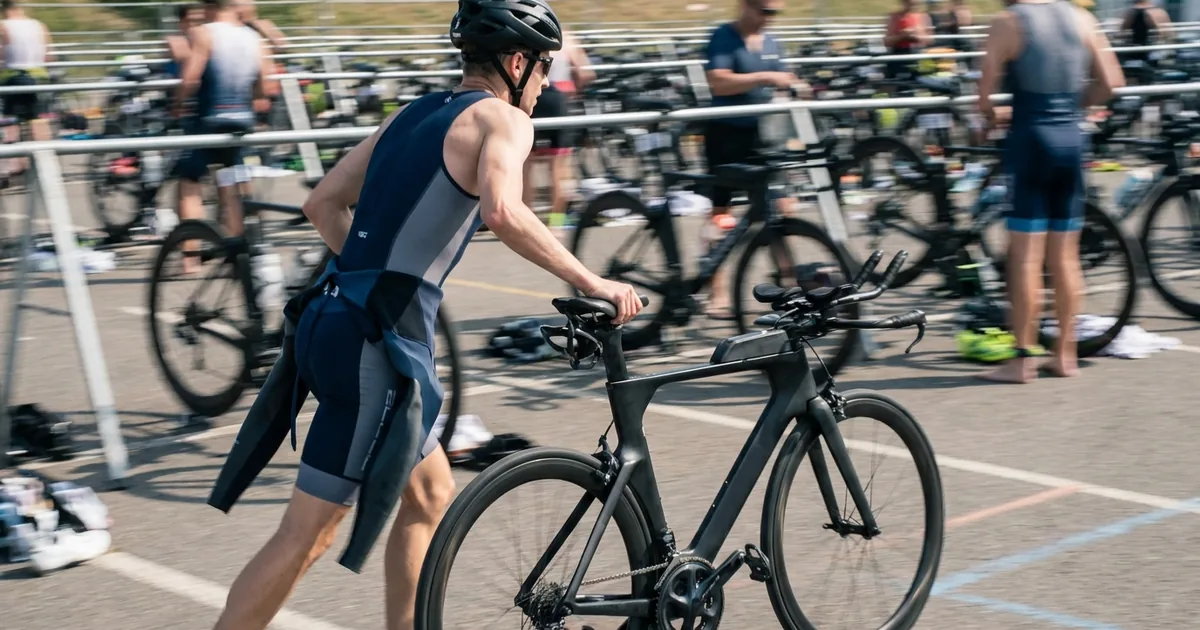
Transitions are part of your official finish time. The clock does not pause while you find your bike, put on socks, fight with a wetsuit, or remember where your gels are. Good transition strategy saves time without demanding more fitness.
Plan T1 from swim exit to bike mount and T2 from bike rack to run exit. Beginners may budget 4 to 8 total minutes for short-course racing and 8 to 15 minutes for long-course racing, depending on race layout and comfort choices.
Why transitions matter more in short races
In a sprint triathlon, losing three minutes in transition can change your entire result tier. In Ironman, the percentage is smaller, but transition mistakes still create stress and can disrupt fueling, pacing, or equipment choices.
T1: swim to bike
T1 starts when you leave the water and ends when you mount the bike. The priorities are staying calm, removing swim gear efficiently, getting helmet and bike gear correct, and leaving with the nutrition you planned.
- Know your rack location from swim-in.
- Helmet on before touching the bike.
- Keep the setup simple and visible.
- Practice wetsuit removal if the race is wetsuit legal.
T2: bike to run
T2 is usually shorter, but it is where many athletes rush and forget run nutrition, race belt, hat, sunglasses, or pacing discipline. The first minute of the run should feel organized, not frantic.
How to estimate transition time
Look at the race map. A long run from swim exit to transition can add minutes before you even touch the bike. Large events may also have long rack rows or changing tents. Put those realities into the triathlon calculator so your finish-time estimate reflects the course.
Practice transitions like a skill. A clean T1 and T2 can be the easiest time you save all season. If you are racing a run-bike-run format, the duathlon calculator lets you model how both transitions affect total time.
What actually happens in a transition
Transitions look like a gear problem and are mostly a sequencing problem. The time is not lost in any single action; it is lost in hesitation between actions, in doing things in an order that requires undoing them, and in searching for equipment that should have been where your hand expected it.
Watch age-group T1 footage and the pattern is consistent. The fast athletes are not moving noticeably faster than the slow ones. They are simply never stopping to decide what to do next. Every movement leads into the following one because the order was fixed in advance and rehearsed until it required no thought.
This matters because transitions arrive at the worst moment for decision-making: disoriented after the swim, or with blood pressure dropping as you come off the bike. Whatever you have not automated, you will improvise badly.
A rehearsed T1 sequence
The specifics vary by race, but the principle is that each step should set up the next:
- Start unzipping and pulling the wetsuit to your waist while running from the swim exit, not at the rack.
- Goggles and swim cap stay in your hand until you reach your spot, so nothing is dropped on the course.
- Wetsuit off the legs by standing on it rather than pulling - faster and far less likely to end in a hamstring cramp.
- Helmet on and buckled before you touch the bike. This is a rule at every race and a disqualification if you get it wrong.
- Sunglasses, race belt, and nutrition in one motion each, from the same spot every time.
- Run the bike to the mount line and mount past it, not on it.
The single largest saving available to most athletes is having shoes already clipped to the pedals and held level with elastic bands. It removes the slowest and most awkward part of T1 entirely, and it is worth practising in an empty car park before racing it.
T2 and the legs that are not yours
T2 is mechanically simpler but physiologically stranger. After hours in the aero position your running muscles have been largely idle and your blood is distributed for cycling. The first few hundred metres genuinely feel wrong, and athletes routinely respond by either panicking or by trying to force normal pace.
Both reactions cost more than the transition itself. The correct response is to expect the sensation, accept a deliberately controlled first kilometre, and let the legs arrive - which they generally do within five to ten minutes.
Practical T2 savings: unclip and get your feet on top of the shoes before dismount, use elastic laces so shoes go on without tying, keep the race belt spin simple, and carry the first gel in your hand rather than stopping to find it.
How much time is really available
Being realistic about the size of the prize prevents both complacency and obsession. In a sprint, transitions can be four to six percent of your total race time, and the gap between a slick and a shambolic pair of transitions is often two to three minutes - enough to change an age-group placing outright.
In an Ironman, the same two to three minutes is a rounding error against a twelve-hour day, and the athletes who lose most in long-course transitions are the ones who rush a task that genuinely deserves care, such as applying sunscreen or getting nutrition into pockets properly.
The rule that follows: optimise transitions aggressively at short course, and optimise them for reliability at long course. A thirty-second saving in an Ironman T1 is not worth forgetting the salt tablets.
Rehearsal, not equipment
Very little of transition speed is purchased. Elastic laces and a race belt cost almost nothing and deliver most of the available gain. Beyond that, the returns come from repetition: setting up a rack in a car park, running through the sequence ten times, and doing it once more while genuinely out of breath so that it holds up under stress.
One habit worth adopting on race morning: walk the route from swim exit to your rack, and from your rack to bike out, counting rack rows and picking a fixed landmark that will still be visible when the racks around you have emptied. More time is lost to athletes who cannot find their bike than to any equipment choice.
When you build the race plan, enter transition times you have actually recorded rather than optimistic guesses. The triathlon finish time calculator treats T1 and T2 as part of the clock, which is the honest way to see what they cost you.
The rules that actually get people penalised
Transitions are where most race penalties happen, and almost all of them are avoidable by knowing four things in advance.
- Helmet before bike, always. Your helmet must be buckled before you take the bike off the rack and stay buckled until it is racked again in T2. This is enforced, and it is a disqualification rather than a time penalty at many races.
- The mount and dismount lines are absolute. Mounting a pedal-stroke before the line or dismounting a step after it draws a penalty. The lines are marked and usually marshalled.
- No littering outside the bin zones. Dropped gel wrappers and bottles outside designated areas carry penalties at most branded races.
- Your space is your space. Gear spread into a neighbour's area, or a bike racked the wrong way round, can be moved by officials and occasionally penalised.
Read the athlete guide for the specific race, because details vary: some events require the bike racked by the saddle, some by the handlebars, and some run bag-based transitions where nothing is racked at all.
Setting up the rack space
Transition areas are crowded, and your allocation is often narrower than you expect. A compact, deliberate setup beats a comprehensive one.
Lay a small brightly-coloured towel as your footprint - it marks your space, gives you somewhere clean to stand, and is the fastest visual landmark when you run in. Place items in the order you will use them, left to right: helmet upside-down on the aerobars with sunglasses inside it and straps splayed open, shoes below, run gear behind. Anything you will not use in T1 should be behind the things you will.
Then rehearse finding it. Count rack rows from a fixed structure that will still be there when the bikes have gone - a tree, a marquee, a lamp post. Bikes are terrible landmarks because most of them leave before you return, and the athletes who lose two minutes in T2 are almost always the ones who navigated by neighbouring bikes in the morning.
Getting a wetsuit off without losing a minute
Wetsuit removal is the single most-botched skill in T1, and the failure mode is predictable: athletes pull at the ankles while standing on one leg, cramp a hamstring, and lose thirty seconds to a minute.
The efficient sequence starts in the water. As soon as you can stand, get the zip down and both arms out while walking, so the suit is at your waist before you reach dry land. Push it to your knees on the run in. At your rack, stand on the fabric with one foot and pull the other leg straight up and out - your bodyweight does the work instead of your grip. Repeat.
Lubricant around the ankles, wrists, and neck before the swim makes the whole thing dramatically easier, and is worth more than any amount of practice at pulling harder. If your race is wetsuit-optional and the water is borderline, remember that the removal cost is part of the calculation.
Cold and wet transitions
Everything above assumes a pleasant day. Cold rain changes the maths, and it is worth having a second plan rather than improvising while shivering.
Wet hands lose dexterity fast, which turns fiddly tasks - buckles, gel wrappers, sunglasses - into genuine time sinks. Cold feet make shoes harder to get into. In those conditions the fastest transition is usually a slightly slower, more deliberate one, and adding a layer that costs forty seconds is frequently worth it because hypothermia on the bike costs far more than that.
Practical cold-weather adjustments: skip the sunglasses, put arm warmers on before the wetsuit so they are already in place, use shoes you can get into without fine motor control, and consider a gilet in the T1 bag for long-course events. Bin the extra layer later if the day warms up.
How much practice this actually needs
Transition speed is one of the highest-return, lowest-cost improvements in triathlon, and it is almost entirely a rehearsal problem rather than an equipment one.
A productive session takes twenty minutes: set up a rack space in a car park or garden, run the full sequence ten times, then do it twice more immediately after a hard effort so it holds up when you are breathing hard and thinking poorly. Most athletes find a minute in the first session.
Do that two or three times in a season and transitions stop being a source of anxiety and become the part of the race you are quietly confident about. Then put your genuine, measured T1 and T2 times into the finish time calculator rather than the optimistic guesses most plans are built on.