
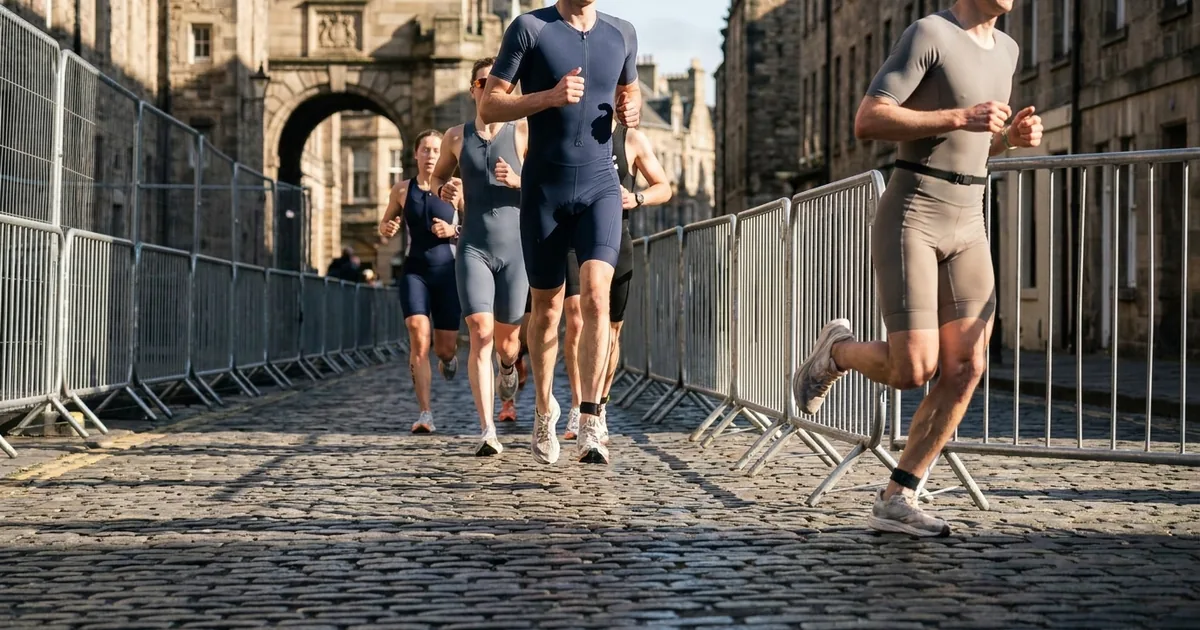
Olympic-distance triathlon sits between short-course speed and long-course control. The race is long enough that pacing mistakes show up clearly, but short enough that a strong athlete can still race with controlled intensity.
A balanced Olympic triathlon plan starts with a controlled 1.5 km swim, a strong but sustainable 40 km bike, and a 10 km run pace you can hold after T2. Use the Olympic triathlon calculator to test sub-3, sub-2:45, and sub-2:30 split combinations.
What makes Olympic pacing different
The Olympic distance rewards athletes who avoid panic in the swim and avoid overbiking. You can push harder than in a 70.3, but the 10K run is long enough to punish a bike effort that was too aggressive.
Sub-3 Olympic triathlon example
A common sub-3 path is roughly 32-35 minutes for the swim, 2-4 minutes in T1, 1:20-1:30 on the bike, 1-2 minutes in T2, and 50-60 minutes on the run. Many different combinations work, but the bike and run need to agree with each other.
How to choose bike speed
Use a speed you can hold without needing a recovery jog at the start of the run. If a slightly faster bike split saves three minutes but costs six minutes on the run, the slower bike plan is faster overall.
When to use a pace calculator
If you already know your swim, bike, and run targets, the pace-to-split converter shows how those paces turn into actual race splits across Olympic and other distances.
Olympic pacing checklist
Before locking a goal, check that each discipline supports the next one. The swim pace should be controlled enough that you can settle quickly on the bike. The bike target should be strong but not so hard that the first 2 km of the run becomes damage control. The run target should assume heavy legs, not a fresh 10K personal best.
If the sub-3 plan depends on a perfect swim, a best-ever bike, and a fresh 10K run pace, it is not a plan yet. Rebuild it with one conservative input and one stretch input so race day has room for wind, heat, traffic in transition, or a crowded swim start.
The distance that punishes both mistakes
Olympic distance sits in an awkward and interesting place. It is long enough that going out too hard is genuinely punished - a 10km run off the bike leaves ample time for an overcooked bike leg to express itself - but short enough that excessive caution costs you real time you can never recover.
Sprint racing forgives aggression because the run is over before the damage lands. Long course punishes it severely. Olympic distance is the format where the pacing decision is finest, and where the difference between a well-judged race and a poorly judged one is largest relative to fitness.
The other complication is that Olympic-distance racing comes in two fundamentally different forms. Draft-legal racing, as seen at elite level, produces a bike leg that is tactical and much faster. Age-group racing is almost always non-drafting, which makes it a straightforward time trial. Bike splits from the two are not comparable.
Choosing an intensity you can defend
For non-drafting Olympic racing, most well-prepared age-group athletes ride somewhere around 0.80 to 0.88 of FTP. That range is deliberately wide because the right value depends heavily on your run durability.
The useful test is not what you can hold on the bike, but what you can hold on the bike and still run 10km at a pace close to your standalone ability. An athlete with a strong run background can usually afford the upper end. An athlete whose run falls apart under fatigue should ride the lower end and will finish faster for it, despite the slower bike split.
The swim, by contrast, should be paced conservatively almost regardless of ability. At around fifteen percent of the race it offers little upside, and starting it hard raises heart rate at exactly the moment when settling into the bike matters most.
Structuring the 10km
The Olympic run is long enough to reward structure and short enough that structure is easy to remember. A reliable approach is to divide it into three phases.
The first two kilometres are for arriving. Legs will feel wrong off the bike, cadence will be short, and the temptation is to force normal pace immediately. Run these deliberately controlled - roughly ten to fifteen seconds per kilometre slower than goal pace - and let the running muscles come back online.
Kilometres three to seven are the body of the race, run at goal pace and by effort rather than by staring at the watch. This is where the bike decision reveals itself: if the pace feels harder than it should, you rode too hard, and the correct response is to accept a slightly slower target rather than to fight it for three more kilometres and then walk.
The final three kilometres are where you spend whatever remains. If the first seven were judged correctly there will genuinely be something left, and finishing an Olympic-distance race able to accelerate is the clearest possible evidence of a well-paced day.
Transitions at Olympic distance
Transitions are roughly three to four percent of an Olympic race - less decisive than in a sprint, but still worth more than most athletes' realistic annual fitness improvement. A ninety-second saving across T1 and T2 is achievable with practice alone.
The trap specific to this distance is treating transitions as leisurely because the race is not short. Athletes who are efficient in sprints often become oddly casual at Olympic distance and hand back two minutes without noticing.
Building the plan
Work backwards from the run, as with every distance. Decide the 10km pace you can hold off the bike, choose the bike intensity that protects it, add a controlled swim and honestly-timed transitions, and check the total.
Build all of it in the Olympic triathlon calculator, then test the aggressive version of the plan against the course adjustment calculator if the race has a hilly bike or a hot run. A sub-three Olympic is a common and worthwhile goal, but it is reached by athletes who ride within themselves and run the last three kilometres well - not by those who post the fastest bike split in their age group and then walk.
Reading a sub-3 target honestly
Sub-three hours is the milestone most age-group Olympic athletes chase, and it is worth breaking down before committing to it. A typical sub-3 shape is a swim around 28 to 32 minutes, transitions of three to four, a bike of about 1:15 to 1:20, and a 10km around 48 to 52 minutes.
Look at that run split. Fifty minutes for 10km is 5:00 per kilometre - and it has to be run after a hard swim and an hour and a quarter of time-trialling. Most athletes who miss sub-3 do not miss it on the bike; they miss it because their standalone 10km is 45 minutes and they assumed the race version would be close to it.
The honest entry requirement is a standalone 10km comfortably under 45 minutes, a bike that can hold 30-plus km/h for 40km without wrecking the legs, and a swim you can complete without drama. If two of those three are missing, a realistic target of 3:10 executed cleanly is a better race and a better stepping stone.
Olympic triathlon splits for every goal time
Sub-3 is the target most age-groupers name, but it is one point on a curve. Here is what each common Olympic goal actually requires, generated from the same split model as our pace chart, on a balanced distribution with 2:30 in T1 and 1:30 in T2.
| Goal | Swim pace | Swim (1.5 km) | Bike speed | Bike (40 km) | Run pace | Run (10 km) |
|---|---|---|---|---|---|---|
| 2:15 | 1:40 /100m | 24:53 | 39.0 km/h | 1:01:34 | 4:27 /km | 44:32 |
| 2:30 | 1:51 /100m | 27:44 | 35.0 km/h | 1:08:37 | 4:58 /km | 49:38 |
| 2:45 | 2:02 /100m | 30:35 | 31.7 km/h | 1:15:40 | 5:28 /km | 54:44 |
| 3:00 | 2:14 /100m | 33:26 | 29.0 km/h | 1:22:43 | 5:59 /km | 59:50 |
| 3:15 | 2:25 /100m | 36:17 | 26.7 km/h | 1:29:46 | 6:30 /km | 1:04:56 |
| 3:30 | 2:37 /100m | 39:08 | 24.8 km/h | 1:36:49 | 7:00 /km | 1:10:02 |
| 4:00 | 2:59 /100m | 44:50 | 21.6 km/h | 1:50:55 | 8:01 /km | 1:20:14 |
Two things to notice. The run paces are held off the bike, not fresh - a 59:50 10 km inside a three-hour Olympic is a harder ask than a standalone sub-60, and athletes who plan from their standalone 10 km time routinely overestimate what they will run. And the bike column moves fastest: the difference between a 3:00 and a 2:30 Olympic is six kilometres per hour on the bike, which is a season of work rather than a good day.
Olympic distance is the one with an exact definition
This is worth knowing if you have ever tried to compare your Olympic time with someone else's. World Triathlon specifies standard distance exactly - 1500 m, 40 km, 10 km - unlike sprint, which the rules define as an upper limit of "up to 750 m / up to 20 km / up to 5 km".
The practical consequence is that Olympic finish times are genuinely comparable between races in a way sprint times are not. When we analysed 5,005 sprint finishers across 21 races, median finish times varied by about 31 minutes between events and the swim's share of the race ranged from 6.5% to 22.8%, because the courses were simply different lengths. At Olympic distance that problem largely disappears, so a benchmark actually means something.
What still varies is the course: elevation, wind, water temperature and whether the bike leg is draft-legal. A draft-legal Olympic bike split is substantially quicker than a non-drafting one and the two are not comparable, which is why the table above assumes age-group non-drafting racing.
Fuelling a two-and-a-half to three-hour race
Olympic distance sits in an awkward fuelling window: long enough that running out matters, short enough that heavy intake causes more problems than it solves.
For most athletes, 30 to 60 grams of carbohydrate per hour is sufficient, taken almost entirely on the bike where absorption is easy and you can carry a bottle. A bottle of sports drink plus one gel across the bike leg covers a typical sub-3 race. On the run, most athletes need nothing beyond water and perhaps one gel if the day is hot or the race is running long.
The error at this distance is usually over-fuelling rather than under-fuelling - athletes apply long-course habits to a three-hour race and arrive at the run with a heavy stomach. Start the race topped up, take what you need on the bike, and keep the run simple.
Course and format variables that move your time
Olympic-distance results are less comparable between races than athletes assume, and a few variables account for most of the spread.
- Draft-legal versus non-drafting. The single largest factor. Age-group racing is almost always non-drafting; elite results are not comparable.
- Wetsuit legality. Worth roughly three to eight percent on the swim for most athletes, decided by water temperature on the morning.
- Bike course profile. A rolling 40km against a flat one can differ by five minutes at identical power.
- Sea versus lake versus river. Chop, current, and sighting difficulty vary the swim more than fitness does.
- Lapped run courses. Turnarounds and congestion cost real time and break rhythm.
This is why comparing your time against a friend's result at a different race tells you very little, and why comparing against your own result on the same course tells you almost everything.
The last three kilometres
Olympic distance is short enough that a strong finish is genuinely available, and it is the clearest diagnostic you have of whether the earlier decisions were right.
If you reach 7km still able to lift the pace, the bike was correctly judged. If you reach 7km hanging on, the answer is not more mental toughness, it is a lower intensity factor next time. Athletes tend to interpret a fading finish as a character issue when it is almost always an arithmetic one made two hours earlier.
Plan the race backwards from that final section: pick the 10km pace you can hold to the end, find the bike effort that protects it in the Olympic triathlon calculator, and check the assumption with the run off the bike calculator before you decide the plan is realistic.