
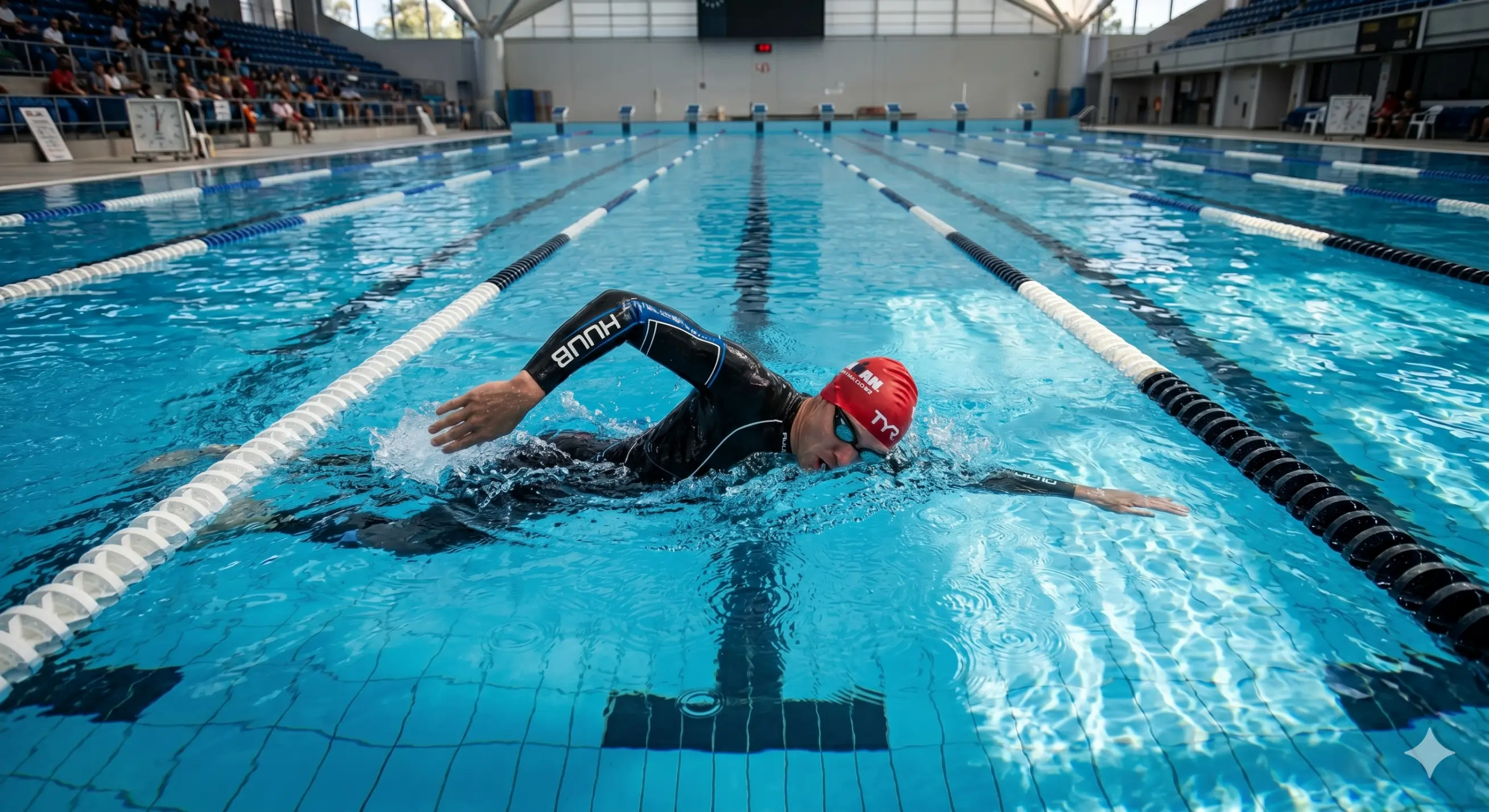
Here's a truth that separates successful Ironman finishers from those who struggle: your race is won or lost in the first 90 minutes.
The 2.4-mile (3.8km) swim isn't just about crossing off the first discipline. It's about exiting the water with enough energy to power through 112 miles on the bike and still have legs for a marathon. Yet countless triathletes make the same fatal mistake—they treat the Ironman swim like a standalone race.
They surge off the start line, fight for position, breathe hard, and burn matches they'll desperately need at mile 20 of the run. By the time they hit T1, they're already in deficit.
This guide changes that. You'll learn science-backed pacing strategies, energy conservation techniques, and race-day execution tactics used by top age-groupers and professionals. Whether you're a first-time Ironman athlete or chasing a PR, these strategies will help you exit the water feeling controlled, confident, and ready to race.
Use our free Ironman pace calculator to model your perfect swim pace and see how it impacts your overall race time.
Quick Answer: Ideal Ironman Swim Pace
The ideal Ironman swim pace is 87-94% of your CSS (Critical Swim Speed) or a Zone 2 effort (60-70% of max heart rate). For most age-groupers, this means adding 10 seconds per 100m to your 1,000m threshold pace. The goal is a "casual walk" effort to exit the water fresh and conserve glycogen for the bike and run.
Key Takeaways
- Pace Conservatively: An Ironman swim is won by exiting fresh, not by setting a PR in the water.
- Conserve Energy: Use a two-beat kick and draft off slightly faster swimmers to save up to 25% of your energy.
- Sight Efficiently: Master the "Alligator Eye" technique every 6-8 strokes to swim perfectly straight.
- Use the Hybrid Method: Track pace as your guide, but use heart rate (under 70% max) as your strict governor.
Table of Contents
- Why Swim Pacing Determines Your Ironman Success
- The Golden Rule: Zone 2 Is Your Friend
- Ironman Swim Pacing by Finish Time
- Energy Conservation Technique #1: Master the Two-Beat Kick
- Energy Conservation Technique #2: Drafting Smart
- Energy Conservation Technique #3: Efficient Sighting
- Heart Rate vs. Pace: Which Should You Track?
- Training for Race-Day Swim Execution
- Race-Day Swim Execution Plan
- The Swim-to-Bike Transition: Protecting Your Effort
- Frequently Asked Questions
- Tools to Plan Your Perfect Race
1. Why Swim Pacing Determines Your Ironman Success
Think of your Ironman as a three-act play. The swim is Act One—and if you blow your lines here, the rest of the performance suffers.
The Physiology of Starting Too Hard
When you swim above your aerobic threshold in the opening discipline, you create a cascade of problems:
- Glycogen depletion accelerates, leaving less fuel for the bike and run
- Lactate accumulates early, forcing your body to work harder to clear it
- Cardiovascular drift begins sooner, making it harder to control effort later
- Mental fatigue sets in from managing elevated stress hormones
The research is clear: drafting in the swim can save 10-25% of your energy, and that's just one technique. Imagine the cumulative savings from pacing smart, kicking efficiently, and sighting well.
The "Fresh Exit" Advantage
Athletes who exit the water feeling controlled report:
- Smoother transitions onto the bike
- Better nutrition absorption in the first hour
- More confidence heading into the longest discipline
- Lower perceived effort at mile 13 of the run
Your goal isn't the fastest swim split. It's the smartest swim split.
2. The Golden Rule: Zone 2 Is Your Friend
If you remember nothing else from this guide, remember this: your Ironman swim should feel easier than you think.
What Zone 2 Means for Swimming
Zone 2 training refers to exercising at a moderate intensity, typically maintaining a heart rate within the range of 60-70% of your maximum heart rate. For Ironman racing, this translates to:
| Metric | Target Range |
|---|---|
| % of Max Heart Rate | 60-70% |
| Beats Below Max HR | 30-50 bpm |
| % of Threshold Pace | 87-94% of CSS pace |
| RPE (1-10 Scale) | 3-4 (Easy-Moderate) |
| Talk Test | Can speak in short sentences |
The "Casual Walk" Analogy
Think of your Ironman swim pace as "the pace of a walk to the start of the race. Not even a brisk walk, a casual walk". This feels painfully slow in the chaos of race morning—but that's exactly the point.
Why it works:
- Your aerobic system can sustain this effort for hours without accumulating fatigue
- You preserve glycogen for the bike and run
- Your stroke mechanics stay clean under fatigue
- You avoid the "swim hangover" that ruins bike performance
The 10-Second Rule
Step-by-Step Summary: How to Calculate Your Ironman Swim Pace
- Test your threshold: Swim a 1,000m time trial (or use recent race data) to find your average threshold pace per 100m.
- Add the buffer: Add exactly 10 seconds per 100m to that baseline pace.
- Apply your pace: This slower time becomes your target Ironman race pace.
- Your 1,000m threshold pace: 1:45/100m
- Your Ironman swim pace: 1:55/100m
- Projected 2.4-mile time: ~1:28
This built-in buffer accounts for open water conditions, navigation, and the need to stay aerobic.
3. Ironman Swim Pacing by Finish Time
Your target pace depends on your overall race goal. Use this Ironman swim pace per 100m chart to find your range:
| Overall Finish Goal | Target Swim Time | Pace per 100m | Pace per 100yd | Avg Speed |
|---|---|---|---|---|
| 9-10 hours | 55-65 min | 1:25-1:40 | 1:18-1:33 | 2.3-2.1 mph |
| 10-11 hours | 1:05-1:15 | 1:40-1:55 | 1:33-1:48 | 2.1-1.9 mph |
| 11-12 hours | 1:15-1:25 | 1:55-2:05 | 1:48-1:57 | 1.9-1.8 mph |
| 12-13 hours | 1:25-1:35 | 2:05-2:15 | 1:57-2:06 | 1.8-1.7 mph |
| 13-14 hours | 1:35-1:45 | 2:15-2:25 | 2:06-2:15 | 1.7-1.6 mph |
| 14-16+ hours | 1:45-2:00+ | 2:25-2:40+ | 2:15-2:27+ | 1.6-1.5 mph |
Important Notes:
- Recreational triathletes typically finish the 2.4-mile swim in 1:10-1:30
- Age-group competitors should prioritize efficiency over speed
- First-time Ironman athletes: As part of a safe Ironman swim strategy for beginners, add 5-10 minutes to your "goal" pace for safety
- Cut-off time: You must maintain at least 3:40/100m to finish under the 2:20 limit. For more Ironman swim cutoff time tips, aim for a consistent 2-beat kick to avoid exhaustion before the bell
The key insight: A 1:30 swim that leaves you fresh is worth far more than a 1:15 swim that destroys your bike leg.
4. Energy Conservation Technique #1: Master the Two-Beat Kick
Your legs are your biggest energy drain in the swim. Fix this, and you unlock massive savings.
What Is the Two-Beat Kick?
A two-beat kick is when you do one kick per arm stroke—kick on the right arm entry, kick on the left arm entry. This is the simplest and most efficient freestyle kicking pattern for distance swimming.
Why it matters:
- A six-beat kick (used by sprinters) can consume 40-60% of your total energy
- A two-beat kick reduces leg energy cost by 60-70%
- You preserve glycogen for the 112-mile bike and 26.2-mile run
When to Use the Two-Beat Kick
The two-beat kick is the most efficient for virtually all distances and fitness levels in open water swimming. It's ideal for:
- Ironman and 70.3 races
- Long training swims
- Athletes with strong upper bodies but weaker legs
- Anyone prioritizing energy conservation
How to Learn It
Drill progression:
- Kick on Side: Swim 25m with one arm extended, one arm at your side, kicking gently. Focus on body rotation, not leg power.
- Single Kick Per Stroke: Consciously kick only once per arm cycle. Count "kick-gliding" rhythm.
- Fist Drill: Swim with closed fists to reduce arm power, forcing reliance on body rotation and minimal kick.
- Progressive Integration: Start with 50m repeats using two-beat kick, gradually building to 400m+ continuous efforts.
Pro tip: A two-beat kick can work across a wide range of tempos (1.1 to 1.9 seconds per stroke), so experiment to find your rhythm.
The Four-Beat Alternative
If the two-beat kick feels unstable (especially in rough water), try a four-beat kick:
- Adds two extra kicks for balance
- Still saves significant energy vs. six-beat
- Helps maintain body position in choppy conditions
5. Energy Conservation Technique #2: Drafting Smart
Drafting is the closest thing to a "free speed" hack in triathlon—and it's 100% legal.
The Science of Swim Drafting
The reduction in resistance provided by drafting can lead to energy savings of up to 25% or more for the drafting swimmer. Some studies on cyclists found drafting saved athletes up to 38%.
Real-world impact:
- You'll save up to 10% of your energy by swimming directly behind or at the hips of another swimmer
- Using a slightly straighter arm recovery combined with drafting can save 15-25% of energy
- You can swim the same pace with significantly lower heart rate and perceived effort
Where to Draft
Three legal drafting positions:
- Directly Behind (Feet Position)
Swim 1-2 feet behind the lead swimmer's feet. Best for: Calm water, straight-line swimming. Challenge: Requires precise sighting. - Hip Drafting (Side Position)
Position yourself at the lead swimmer's hip, slightly offset. Best for: Easier sighting, maintaining visual contact. Advantage: Less likely to kick the swimmer in front. - Diagonal Drafting
Swim at a 45-degree angle off the lead swimmer's shoulder. Best for: Rough water, navigating around slower swimmers. Bonus: Easier to pass if needed.
Open Water Swim Drafting Rules Ironman
Drafting is legal, but respect matters when following the open water swim drafting rules in Ironman:
✅ Do:
- Maintain consistent spacing (don't surge into their feet)
- Sight efficiently to avoid zigzagging
- Pass cleanly if you're faster (swim wide, don't climb over)
- Follow the bubbles of another swimmer to sight less often
❌ Don't:
- Grab, hold, or push off the swimmer
- Swim so close you make contact repeatedly
- Draft off someone who's clearly off-course
- Block others from drafting behind you
How to Practice Drafting
Most triathletes never practice drafting—then wonder why it feels chaotic on race day.
Training drills:
- Pool Drafting: With a training partner, swim 100-200m repeats drafting off their feet. Focus on maintaining position without surging.
- Open Water Simulation: In group swims, practice rotating through drafting positions. Learn to sight while maintaining the draft.
- Sighting While Drafting: Follow the bubbles of another swimmer, lifting your head only every 6-8 strokes to confirm direction.
Race-day strategy: In the first 200m, expect chaos. Once the pack sorts out (usually by the first buoy), find a swimmer slightly faster than your target pace and lock in behind them.
6. Energy Conservation Technique #3: Efficient Sighting
Poor sighting is the silent killer of Ironman swim performance. Swim straight, sight efficiently, and save massive energy.
The Cost of Bad Sighting
Every time you lift your head to sight:
- Your hips drop, increasing drag
- Your rhythm breaks
- Your heart rate spikes
- You lose forward momentum
Athletes who sight inefficiently can add 100-300 extra meters to their 3.8km swim—that's 5-10% wasted effort.
How to Swim Straight Open Water Triathlon: The Perfect Sighting Technique
Step-by-step:
- Time Your Sight: Lift your head as your lead arm enters the water and extends forward
- Use the "Alligator Eye" Method: Lift just enough so your eyes clear the waterline—think alligator, not giraffe
- Push Down Slightly: As your arm enters, press down gently to lift your upper body
- Keep It Brief: Your head should be up for less than 1 second. Stay relaxed through the neck and shoulders. The goal is to see forward while keeping momentum and rhythm.
- Breathe After: Take your breath on the next stroke cycle, not during the sight
How Often Should You Sight?
General guidelines:
- Every 6-8 strokes in calm water with clear landmarks
- Every 4-6 strokes in choppy water or strong currents
- Every lap in training to build muscle memory, regardless of workout
- More frequently in the first 400m to establish line accuracy
Pro tip: Start practicing sighting every six strokes in training. Lift your head slightly as you move forward, take a quick glimpse, then move your head to the side to breathe.
Pre-Race Sighting Prep
The day before:
- Study the course map and identify key landmarks
- Note the buoy colors and turn sequence
- Identify tall structures (buildings, towers, trees) visible from water level
Race morning:
- During the warm-up, sight the first buoy from the start line
- Identify backup landmarks in case buoys are hard to see
- Note sun position (glare can obscure buoys)
Sighting While Drafting
When drafting, you can sight less often:
- Follow the bubbles of the swimmer in front
- Lift your head every 8-10 strokes to confirm you're still on course
- If the lead swimmer zigzags, don't follow—sight more and adjust
7. Heart Rate vs. Pace: Which Should You Track?
This is one of the most debated questions in triathlon pacing. Here's the truth: both matter, but in different ways.
Why Heart Rate Is Valuable
Advantages:
- Accounts for conditions (current, waves, wind)
- Reflects your actual physiological effort
- Prevents over-exertion on hard days
- Shows cumulative fatigue from training
Target for Ironman swim: 60-70% of max heart rate, or 30-50 beats below maximum.
Limitations: Heart rate lags at the start (adrenaline delays response), hard to monitor in open water (requires waterproof watch), can be affected by caffeine, dehydration, temperature, and doesn't account for efficiency improvements.
Why Pace Matters
Advantages:
- Direct measure of performance
- Easy to track (pool clocks, GPS watches)
- Helps you hit target split times
- Builds pace awareness for race day
Target for Ironman swim: 87-94% of your CSS pace (Critical Swim Speed).
Limitations: Doesn't account for currents or conditions, can tempt you to push too hard, GPS is unreliable in open water, and ignores how you actually feel.
The Hybrid Approach (Recommended)
Best practice: Use pace as your primary guide, heart rate as your governor.
How it works:
- Pre-race: Determine your target pace range (e.g., 1:55-2:00/100m)
- During the swim: Focus on holding target pace. Check heart rate at key checkpoints (first buoy, halfway, final buoy). If HR exceeds 70% of max, ease back even if pace feels comfortable.
- Adjust for conditions:
- With current: Pace will be faster—monitor HR to avoid over-exertion
- Against current: Pace will be slower—trust HR to confirm effort is correct
- Rough water: Expect both pace and HR to be elevated; focus on RPE
RPE: The Forgotten Metric
Rate of Perceived Exertion (RPE) on a 1-10 scale is incredibly valuable:
- Zone 2 Ironman swim effort: 3-4 out of 10
- Talk test: You should be able to speak short sentences
- Breathing rhythm: Controlled, not labored
When in doubt, trust RPE. Your body knows effort better than any device.
8. Training for Race-Day Swim Execution
You can't execute a smart race-day swim if you've never practiced it. Here's how to train specifically for Ironman swim pacing.
Key Training Principles
1. Specificity Matters
Your pool training should transpose to open water swimming—don't try to change mechanics right before the race. However, you must include open water sessions to practice sighting in real conditions, drafting off other swimmers, navigating without lane lines, and managing waves and chop.
2. Volume Builds Confidence
While you don't need to swim 2.4 miles in training repeatedly, you should build to:
- One 2,000-3,000m continuous swim 4-6 weeks before race day
- Multiple 1,500-2,000m efforts at race pace throughout your build
- Weekly long swims of 60-90 minutes in the final 12 weeks
3. Race Pace Rehearsal
Incorporate these sessions:
The 220s Drill
- Swim 300m at Ironman race pace
- Rest 30-45 seconds
- Repeat 4-6 times
- Builds pace awareness and endurance
The Threshold Test
- 1,000m time trial (all-out effort)
- Use average pace to calculate race pace (+10 sec/100m)
- Repeat every 6-8 weeks to track fitness
The Race Simulation
- 4,200m continuous at race effort (or 2 x 1,800m with 2:00 rest)
- Practice nutrition (if you plan to take gels mid-swim)
- Wear your race goggles and wetsuit
Sample 12-Week Build
- 3 swims/week
- Focus: Technique, Zone 2 volume
- Long swim: 1,500-2,000m continuous
- 3-4 swims/week
- Add: 1 race-pace session (e.g., 10 x 100m at IM pace, 20 sec rest)
- Long swim: 2,000-2,500m continuous
- Include 1 open water session/week
- 3-4 swims/week
- Key session: 2 x 1,800m at race pace with 2:00 rest
- Long swim: 3,000m+ continuous
- Practice drafting, sighting, wetsuit removal
- Reduce volume by 40-50%
- Maintain race-pace efforts (shorter repeats)
- Focus: Sharpness, confidence, rest
Open Water Practice Is Non-Negotiable
The single best thing you can do to improve your swim pacing is to rehearse it in open water training. Sessions that specifically practice holding controlled effort in open water are essential.
Minimum requirement: 6-8 open water swims before race day, including:
- 2-3 sessions practicing drafting
- 2-3 sessions focused on sighting accuracy
- 1-2 full race-pace rehearsals (1,500m+ continuous)
9. Race-Day Swim Execution Plan
You've trained. You've practiced. Now it's time to execute. Follow this step-by-step plan.
Pre-Race (2 Hours Before Start)
Nutrition:
- Eat a familiar, easily digestible breakfast 2-3 hours before start
- Sip electrolyte drink (not just water)
- Optional: Small gel or chew 30 minutes before start if you tolerate it
Gear Check:
- Goggles (plus backup)
- Wetsuit (if allowed)
- Swim cap (provided by race)
- Body lubricant (reduce chafing)
- Timing chip
Mental Prep:
- Review your target pace range
- Visualize a controlled, smooth swim
- Identify your "why" for race day
Warm-Up (30-45 Minutes Before)
In the water:
- 400-600m easy swim to activate muscles
- 4 x 50m build (progressive effort) to open up lungs
- 2-3 practice sights to identify first buoy
- Test wetsuit flexibility (if wearing)
On land:
- Dynamic stretching (arm circles, leg swings)
- Light jog or jump rope to elevate heart rate slightly
- Final bathroom stop
The Start (0-400m): Survive the Chaos
What to expect: Adrenaline surge, contact with other swimmers, difficulty sighting, temptation to sprint.
Your strategy:
- Position smartly: Seed yourself honestly based on pace (not ego)
- Stay wide if needed: Avoid the pack center if you're not comfortable
- Control your breathing: First 100m will feel frantic—focus on long exhales
- Don't match surges: Let faster swimmers go; your pace is YOUR pace
- Sight more frequently: Every 4-6 strokes until you clear the pack
Heart rate will be elevated—this is normal. Don't panic. Settle into rhythm by the first buoy.
The Middle (400m-3,200m): Lock Into Rhythm
This is where your race is won.
Your strategy:
- Find a draft: Identify a swimmer slightly faster than your target pace. Position at their hips or directly behind. Maintain 1-2 feet spacing. Sight every 8-10 strokes.
- Check your effort: RPE should be 3-4 out of 10. Breathing should be controlled (every 2-3 strokes). If HR monitor available: 60-70% of max.
- Stay relaxed: Shoulders down, neck loose. Long, smooth strokes. Two-beat kick to conserve energy.
- Navigate turns efficiently: Approach buoys wide to avoid traffic. Use the "overshoot and turn wide" method. Sight the next buoy before completing the turn.
- Manage contact: If kicked or bumped, don't panic. Roll onto your back briefly if needed to reset. Stay calm—everyone experiences this.
The Finish (3,200m-3,800m): Prepare for T1
Last 600m strategy:
- Increase stroke rate slightly (not effort)
- Add a touch more kick (transition to 4-beat if needed)
- Sight frequently to hit the exit straight
- Mental shift: "I'm almost done—stay smooth"
Final 100m: If you feel good, gradually increase effort. Don't sprint—save energy for wetsuit removal. Focus on clean exits (stand when water is shallow enough).
10. The Swim-to-Bike Transition: Protecting Your Effort
You've swum smart. Now protect that effort in T1.
The Physiology of T1
When you come out of the water, all the blood's still in your arms—so ease into the bike. Your body needs 5-10 minutes to redistribute blood flow from upper body (swim) to lower body (bike).
What this means:
- Your legs will feel heavy and weird (this is normal)
- Your heart rate will be elevated from the swim
- Don't panic if your bike power is low in the first 5 minutes
T1 Execution Checklist
- ☐Stand when water is mid-thigh deep
- ☐Begin removing wetsuit top as you walk/run
- ☐Don't sprint to transition—smooth jog is fine
- ☐Remove wetsuit completely (use lubricant to speed this up)
- ☐Dry feet quickly (small towel)
- ☐Put on helmet, sunglasses, cycling shoes
- ☐Grab bike and nutrition
- ☐Run to bike mount line
- ☐Keep effort EASY (Zone 1-2)
- ☐Focus on spinning legs, not power
- ☐Take small sips of fluid
- ☐Let your body adjust before pushing
Pro tip: Practice swim-to-bike transitions regularly in training. Do brick workouts (swim-bike or bike-run) to teach your body the transition.
11. Frequently Asked Questions
Q: What's a good Ironman swim time for a first-timer?
A: For recreational triathletes, a good full Ironman swim time ranges from 1:10-1:30 for the 2.4-mile distance. First-timers should prioritize finishing feeling controlled over hitting a specific time. Aim for the 1:20-1:35 range if you're newer to distance swimming.
Q: Should I wear a wetsuit for the Ironman swim?
A: If water temperature allows (usually below 76.1°F/24.5°C), yes. Wetsuits provide buoyancy, warmth, and speed. One of the best Ironman wetsuit tips race day offers is to practice swimming in your wetsuit extensively beforehand to avoid feeling restricted, and use body lubricant on your neck and wrists for a fast T1 removal.
Q: How to not panic in Ironman swim?
A: Practice open water swimming extensively before race day. Use these strategies: start at the side or back of the pack to avoid contact, focus on long, controlled exhales underwater, roll onto your back to reset if needed, and remember: thousands of athletes have felt this way and succeeded.
Q: Can I walk during the Ironman swim?
A: Technically yes, but it's not recommended. Walking wastes time and energy. If you need to rest, roll onto your back and float while catching your breath, then resume swimming.
Q: What if I miss a buoy or go off course?
A: Don't panic. Sight more frequently to reorient yourself. If you've gone significantly off course, it's better to correct early than continue in the wrong direction. Most athletes add 100-200m from imperfect navigation—factor this into your pacing.
Q: Should I take nutrition during the swim?
A: Most athletes don't eat during the Ironman swim, but some take 1 gel 20-30 minutes before the finish if they tolerate it. Practice this in training first. Hydration isn't necessary for the swim itself.
Q: How do I know if I'm swimming too hard?
A: Warning signs include: breathing feels labored or panicked, you can't hold a conversation (even short sentences), your stroke breaks down, you're surging to keep up with faster swimmers, heart rate exceeds 70% of max (if monitoring). If any of these occur, slow down immediately. The bike will punish swim overexertion.
Q: Is it better to swim alone or draft?
A: If you can find a swimmer slightly faster than your target pace and draft legally, you'll save 10-25% energy. However, if drafting causes stress, navigation issues, or contact anxiety, swimming alone at your own pace is better. Practice both in training.
12. Tools to Plan Your Perfect Race
Execution starts with planning. Use our free Tri Split Calculator to:
- Model target swim/bike/run splits based on your fitness
- Test different swim pacing scenarios (conservative vs. aggressive)
- See how a 5-minute faster/slower swim impacts your overall time
- Build a personalized race-day execution plan
- Export your race plan to share with coaches or training partners
Remember: The fastest swimmers don't always win. The smartest swimmers do.
Ready to build your race plan? Visit TriSplitCalc.com to model your perfect Ironman split—free, no signup required.
Disclaimer: This content is for educational purposes. Consult a coach or sports medicine professional before making significant changes to your training or racing strategy. © 2026 TriSplitCalc.com. All rights reserved.