
You've trained for months. You've nailed your long bricks. You've dialed in your nutrition.
But there's one question that keeps you up at night: "What's my realistic Ironman finish time?"
Guess wrong, and you risk:
- Pacing too hard → bonking at mile 20 of the run
- Pacing too easy → leaving hours on the course
- Poor race planning → missed nutrition windows, transition chaos, mental fatigue
The truth? Accurate finish time prediction isn't guesswork. It's math, physiology, and smart planning.
That's where an Ironman pace calculator comes in.
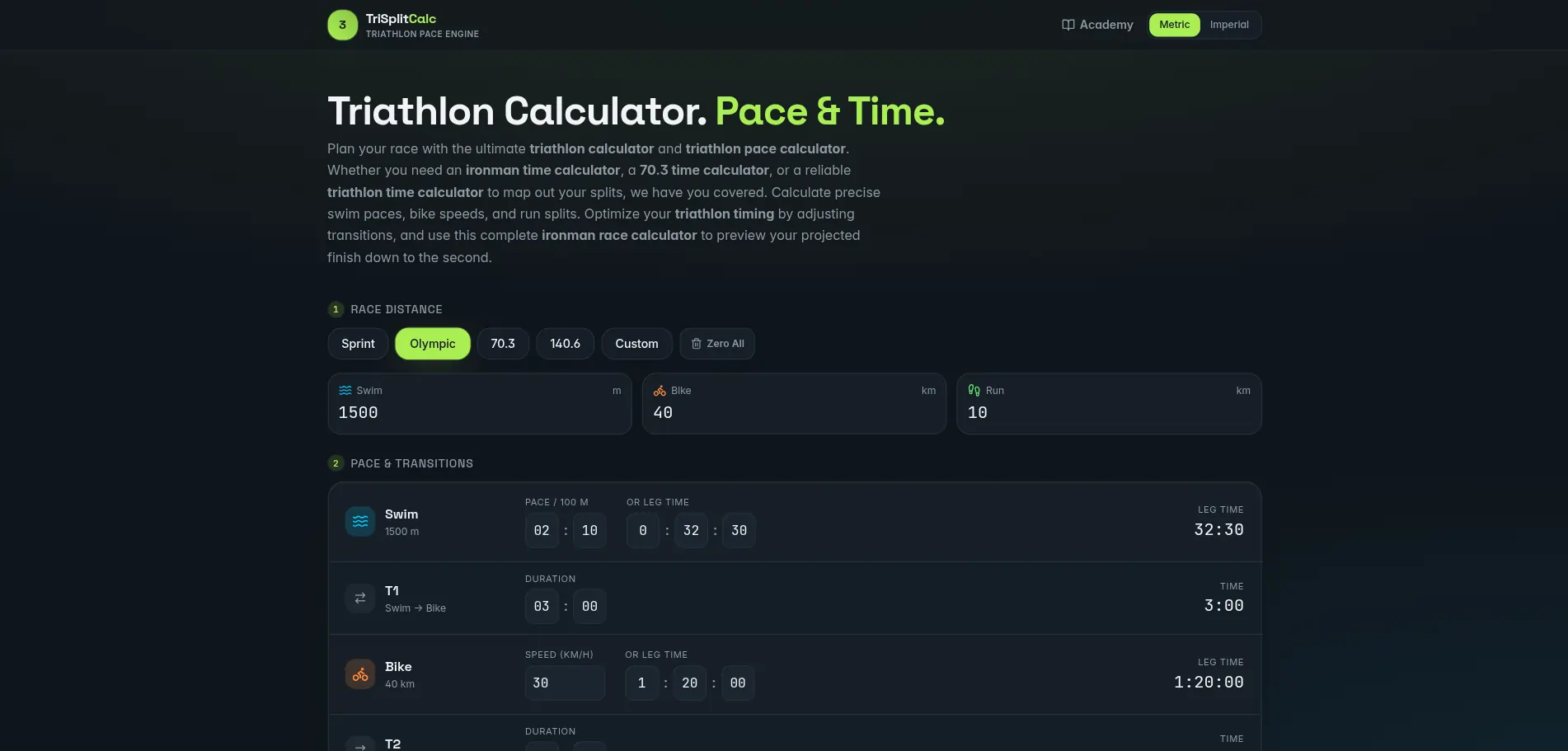
This pillar guide shows you how to build a practical 140.6 finish-time estimate—using transparent frameworks, realistic inputs, and our free Tri Split Calculator to model a race-day plan you can test in training.
Whether you're targeting a sub-10-hour PR or a strong first-time finish, this guide gives you the tools to plan smarter, race calmer, and finish stronger.
Model Your Split Now
Ready to model your split now? Visit TriSplitCalc.com to build your personalized Ironman pace plan—free, no signup required.
1. Why Finish Time Prediction Is Hard (And Why Most Get It Wrong)
The "Standalone Race" Fallacy
Most athletes calculate their Ironman time like this:
- Swim PR: 1:15
- Bike PR: 5:30
- Marathon PR: 3:45
- Total: ~10:30
The problem: An Ironman isn't three standalone races. It's one continuous metabolic challenge where fatigue, fueling, and pacing compound across disciplines.
Research shows that athletes who use standalone PRs to predict Ironman time overestimate performance by 45-90 minutes on average.
The Hidden Variables Most Calculators Ignore
| Factor | Impact on Finish Time | Often Overlooked? |
|---|---|---|
| Course elevation | +15-45 min for hilly courses | ✅ Yes |
| Heat/humidity | +10-30 min due to slower pace & hydration stops | ✅ Yes |
| Wind conditions | +5-25 min on exposed bike courses | ✅ Yes |
| Transition efficiency | +3-10 min for age-groupers | ✅ Yes |
| Nutrition/GI issues | +10-60 min if problems arise | ✅ Yes |
| Pacing discipline | ±30-90 min based on execution | ✅ Yes |
A great Ironman pace calculator accounts for these variables—not just raw fitness.
Why Generic Online Calculators Fall Short
Many free tools use simple formulas like:
Finish Time = (Swim Pace × 3.8) + (Bike Pace × 180) + (Run Pace × 42.2)But this ignores:
- Fatigue accumulation across disciplines
- The non-linear relationship between training pace and race pace
- Individual variability in durability and fueling tolerance
The result: Predictions that look precise but lack real-world accuracy.
Better Approach
Use a dynamic calculator that lets you adjust for course profile, expected conditions, and your personal pacing strategy. That's exactly what our Tri Split Calculator is built to do.
2. What Is an Ironman Pace Calculator?
Simple Definition
An Ironman pace calculator is a tool that helps you estimate your finish time for a 140.6-mile triathlon by modeling:
- Your target pace/power for swim, bike, and run
- Transition times
- Course-specific adjustments (elevation, wind, temperature)
- Fueling and fatigue factors
Types of Pace Calculators
| Type | Pros | Cons | Best For |
|---|---|---|---|
| Simple time-adder | Easy to use; quick estimate | Ignores fatigue, course, conditions | Very rough planning |
| Fitness-based predictor | Uses FTP, CSS, marathon pace | Requires accurate fitness data | Trained athletes with testing data |
| Dynamic scenario planner | Adjusts for course, weather, strategy | Slightly more complex input | Serious racers planning execution |
| AI/ML-powered tools | Learns from race data patterns | May require account/signup | Data-driven athletes |
Our recommendation: Use a dynamic, scenario-based calculator that puts you in control of the variables. That's the philosophy behind TriSplitCalc.com.
What Makes a Great Pace Calculator?
- ✅ Discipline-specific inputs: Swim pace/100m, bike power/HR, run pace/mile
- ✅ Transition time fields: Realistic T1/T2 estimates for age-groupers
- ✅ Course adjustment sliders: Elevation, wind, temperature modifiers
- ✅ "What-if" scenario testing: See how small changes impact final time
- ✅ Exportable race plan: Download or share your split strategy
- ✅ Mobile-friendly: Accessible on race morning from your phone
Try It Now
Build your personalized Ironman split at TriSplitCalc.com—free, no signup, instant results.
3. How to Use a Pace Calculator: Step-by-Step
Follow this framework to generate a realistic, actionable finish time prediction.
Step 1: Gather Your Baseline Data
Before opening any calculator, collect:
| Discipline | Key Metric | How to Find It |
|---|---|---|
| Swim | Critical Swim Speed (CSS) or 100m threshold pace | 1,000m time trial ÷ 10; or recent open water race |
| Bike | Functional Threshold Power (FTP) or threshold HR | 20-min FTP test × 0.95; or recent hilly time trial |
| Run | Marathon or half-marathon race pace | Recent race result or tempo run average |
| Transitions | Practice T1/T2 times | Time yourself in training; add 30-60 sec for race chaos |
Don't have test data? Use conservative estimates and adjust later.
Step 2: Input Your Targets into the Calculator
Using Tri Split Calculator as an example:
- Select your goal finish time range (e.g., 10:30-11:00)
- Enter discipline targets:
- Swim: 1:50/100m → ~1:16 for 3.8km
- Bike: 72% FTP → ~5:45 for 112 miles
- Run: 9:45/mile → ~4:15 marathon
- Add transition buffers: T1: 6 min, T2: 4 min
- Review auto-calculated total: ~11:26
Step 3: Adjust for Course & Conditions
Most calculators let you apply modifiers:
| Condition | Typical Adjustment | How to Apply |
|---|---|---|
| Hilly bike course | +5-10% to bike time | Reduce target FTP % or add time buffer |
| Hot/humid race | +3-8% to all disciplines | Lower pace targets; increase hydration time |
| Windy exposed course | +2-5% to bike time | Add buffer or reduce power target |
| First Ironman | +10-15% overall | Start conservative; prioritize finishing |
Pro Tip: Model 3 Scenarios
- Optimistic: Ideal conditions, perfect execution
- Realistic: Expected course/weather, minor hiccups
- Conservative: Tough conditions, GI issues, pacing errors
Try all three at TriSplitCalc.com to build confidence across scenarios.
Step 4: Export & Refine Your Race Plan
A great calculator doesn't just give a number—it gives a plan.
Your output should include:
- Hour-by-hour split targets
- Nutrition timing aligned with pace
- Key checkpoints (e.g., "Hit mile 56 by 3:15")
- Contingency notes ("If behind at halfway, don't chase—stay disciplined")
Next step: Print or save your plan. Review it with your coach. Practice the pacing in training.
4. Key Factors That Impact Your Finish Time
Understanding these variables helps you use a pace calculator more intelligently.
1. Fitness Baseline (The Foundation)
Your predicted time starts with your current fitness. But remember:
- Training pace ≠ race pace: Ironman race pace is typically 10-20% slower than standalone efforts due to cumulative fatigue
- Durability matters: Two athletes with same FTP may have very different 8-hour power sustainability
- Test realistically: Use long-course specific tests (e.g., 2-hour bike at target Ironman effort), not just FTP
2. Course Profile (The Great Equalizer)
| Course Type | Typical Time Impact | Pacing Strategy |
|---|---|---|
| Flat & fast | Baseline prediction | Hold steady power; aero discipline critical |
| Moderately hilly | +15-30 min | Reduce power on climbs; recover on descents |
| Very hilly/mountainous | +30-60 min | Prioritize run durability over bike speed |
| Technical bike course | +10-25 min | Focus on handling; avoid surging on corners |
Use your calculator to test: How does adding +20 min to your bike split impact your run prediction? Model it at TriSplitCalc.com.
3. Weather & Environmental Conditions
| Condition | Physiological Impact | Calculator Adjustment |
|---|---|---|
| Heat (>80°F/27°C) | ↑ Heart rate, ↑ fluid needs, ↓ gut absorption | Reduce pace targets by 5-8%; increase hydration time |
| Humidity (>70%) | Impaired cooling, ↑ perceived effort | Same as heat; prioritize electrolyte intake |
| Wind (>15 mph) | ↑ Power demand on bike, drafting challenges | Add 2-5% to bike time; focus on aero position |
| Cold/rain | ↓ muscle temp, ↑ injury risk, navigation challenges | Add transition time; plan for slower bike handling |
4. Nutrition & Gut Tolerance
Even perfect pacing fails if fueling breaks down.
| Scenario | Typical Time Impact | Mitigation Strategy |
|---|---|---|
| GI distress | +20-60 min (or DNF) | Practice race-day nutrition; start conservative |
| Under-fueling | +30-90 min due to bonking | Use calculator to align fueling schedule with splits |
| Over-hydration | +10-30 min from hyponatremia risk | Match fluid intake to sweat rate, not arbitrary goals |
Pro tip: Use your pace calculator to schedule nutrition stops. Example: "At 70g carbs/hour, I need a gel every 20 minutes—align with aid stations."
5. Pacing Discipline (The X-Factor)
Two athletes with identical fitness can finish 45+ minutes apart based on pacing execution.
Common pacing errors that inflate finish time:
- Swimming 10% faster than target → elevated HR → compromised bike start
- Pushing bike power 5% above target → glycogen depletion → walk-run marathon
- Starting run too fast → positive split → mental fatigue → missed time goal
The fix: Use your calculator to set effort-based targets (HR, power, RPE), not just pace. Then trust the process on race day.
5. Sample Predictions: From First-Timer to Sub-10
See how realistic predictions look across athlete profiles. All modeled using Tri Split Calculator.
Profile A: First-Time Ironman (Conservative Goal)
| Metric | Value |
|---|---|
| Target Finish | 13:30 |
| Swim | 1:35 (2:30/100m) |
| T1 | 8 min |
| Bike | 6:45 (16.7 mph avg) |
| T2 | 6 min |
| Run | 5:16 (12:05/mile) |
| Key Strategy | Walk breaks every mile after mile 10; prioritize finishing strong |
Why this works: Conservative pacing preserves energy for the marathon. Walk-run strategy reduces injury risk and GI distress.
Profile B: Experienced Age-Grouper (Targeting 11:30)
| Metric | Value |
|---|---|
| Target Finish | 11:30 |
| Swim | 1:15 (1:58/100m) |
| T1 | 5 min |
| Bike | 5:50 (19.2 mph avg @ 75% FTP) |
| T2 | 4 min |
| Run | 4:16 (9:48/mile) |
| Key Strategy | Even-effort bike; negative split run; structured walk breaks after mile 12 |
Why this works: Balanced discipline splits avoid over-reliance on any single leg. Run strategy accounts for cumulative fatigue.
Profile C: Sub-10 Contender (Aggressive but Realistic)
| Metric | Value |
|---|---|
| Target Finish | 9:45 |
| Swim | 58 min (1:32/100m) |
| T1 | 3 min |
| Bike | 4:55 (22.7 mph avg @ 82% FTP) |
| T2 | 2 min |
| Run | 3:47 (8:40/mile) |
| Key Strategy | Aggressive but controlled bike; run off the bike practiced extensively; nutrition dialed at 85g/hour |
Why this works: High fitness + precise execution + optimized fueling. Only attempt if you've validated targets in long-course training.
Model your own profile at TriSplitCalc.com. Adjust sliders to see how small changes impact your final time.
6. How to Adjust for Course, Weather & Conditions
A static prediction is useless if your race day looks different from your training. Here's how to adapt.
Course-Specific Adjustments
For hilly bike courses (e.g., Ironman Lake Placid, Nice):
- Reduce target bike power by 5-10%
- Add +15-30 min to bike split prediction
- Prioritize run durability over bike speed
- Practice climbing in the saddle during training
For flat/fast courses (e.g., Ironman Texas, Florida):
- Hold target power more consistently
- Focus on aero position to maximize speed
- Beware of crosswinds—practice handling
- Don't get sucked into drafting penalties
For technical courses (tight turns, rough roads):
- Add +5-10 min to bike time for handling
- Practice race-pace efforts on similar terrain
- Prioritize smooth transitions over raw speed
Weather Contingency Planning
Use your calculator to build "if-then" scenarios:
IF temperature > 85°F (29°C):
  → Reduce bike power target by 8%
  → Increase fluid target by 200ml/hour
  → Add +20 min to overall prediction
  → Prioritize electrolyte intake over carb density

IF wind > 20 mph on bike:
  → Focus on aero position over wattage
  → Add +15 min to bike split
  → Conserve energy for run

IF rain expected:
  → Add +3 min to T1/T2 for gear changes
  → Practice bike handling in wet conditions
  → Pack extra nutrition in waterproof bags
Pro tip: Save multiple scenario plans in Tri Split Calculator and review the night before the race based on the forecast.
The "Race Morning Recalculation"
Conditions can change. Build flexibility into your plan:
- Check the forecast 2 hours before start
- Open your calculator on your phone
- Adjust 1-2 key variables (e.g., reduce bike power by 5% for heat)
- Export updated split targets to your watch or race belt
- Trust the adjusted plan—don't revert to "original" targets out of ego
This 5-minute ritual can save 30+ minutes of suffering later.
7. From Prediction to Execution: Race-Day Planning
A prediction is only valuable if it drives action. Here's how to turn your calculator output into race-day execution.
Step 1: Create an Hour-by-Hour Race Plan
Use your calculator's output to build a timeline:
| Time | Discipline | Target | Fueling | Notes |
|---|---|---|---|---|
| 0:00-1:15 | Swim | 1:50/100m | None | Draft if possible; sight efficiently |
| 1:15-1:21 | T1 | 6 min | First gel at 1:18 | Grab bike nutrition immediately |
| 1:21-7:06 | Bike | 72% FTP | 80g carbs/hour | Set 20-min timer; reduce power on climbs |
| 7:06-7:10 | T2 | 4 min | Half-gel at 7:08 | Take 3 deep breaths before run |
| 7:10-11:25 | Run | 9:45/mile | 50g carbs/hour | Walk breaks after mile 10; aid station strategy |
Generate your personalized timeline at TriSplitCalc.com.
Step 2: Program Your Watch or Device
Most GPS watches allow custom alerts:
- Pace/power alerts: "Bike power > 220W? Slow down"
- Fueling reminders: "Time for gel" every 20 minutes
- Split checkpoints: "Mile 13 run: target 2:08"
Pro tip: Use vibration alerts (not sound) to avoid distracting others.
Step 3: Build Mental Checkpoints
Numbers on a screen aren't enough. Anchor your plan to mental cues:
- Swim exit: "Heart rate settling, breathing controlled"
- Bike halfway: "Power steady, legs fresh, nutrition on track"
- Run start: "First mile 5 sec/mile slower than goal—discipline"
- Mile 20 run: "This is where races are won—trust training"
Step 4: Prepare Contingency Scripts
What if things go off-plan? Have pre-written responses:
IF bike power drops 10% due to headwind:
  → Don't chase watts; hold RPE 6
  → Add +15 min to run prediction mentally
  → Focus on smooth pedaling, not speed

IF GI distress hits at mile 10 of run:
  → Walk 60 seconds; sip water
  → Take 15g fast carbs (cola, gel bite)
  → Reset mental focus: "Next aid station"

IF running behind prediction at halfway:
  → Don't surge to "make up time"
  → Stay in target effort zone
  → Trust that even pacing yields fastest finish
Download your contingency checklist from TriSplitCalc.com after modeling your splits.
8. Common Calculator Mistakes & How to Avoid Them
Even great tools produce bad outputs if used incorrectly. Avoid these pitfalls.
Mistake #1: Using Standalone PRs as Inputs
Problem: Plugging in your open-water 1.5km PR, FTP test, and marathon PR as if they add linearly.
Fix: Apply a "long-course fatigue factor": reduce standalone paces by 10-20% for Ironman predictions.
Mistake #2: Ignoring Transition Time
Problem: Assuming T1/T2 take 2 minutes like elites.
Fix: Time yourself in training. Add 30-60 seconds for race-day chaos. Most age-groupers need 5-10 min total.
Mistake #3: Over-Optimizing for Ideal Conditions
Problem: Modeling only ideal weather, a flat course, and clean execution.
Fix: Always build a "realistic" and "conservative" scenario. Hope for the best; plan for the rest.
Mistake #4: Setting and Forgetting
Problem: Creating a plan 3 months out and never revisiting it.
Fix: Recalculate 4 weeks out (after final long bricks), 1 week out (after taper), and race morning (after forecast check).
Mistake #5: Treating Prediction as Promise
Problem: Getting emotionally attached to a specific time, leading to poor race-day decisions.
Fix: View predictions as guides, not guarantees. Your goal is smart execution, not hitting a number.
Stay flexible: Use Tri Split Calculator to model multiple scenarios and build confidence across outcomes.
9. Frequently Asked Questions
Q: How accurate can an Ironman pace calculator really be?
A: With good input data and realistic adjustments, predictions can be within ±15-30 minutes of actual finish time for experienced athletes. First-timers may see ±45-60 minute variance due to unknown race-day factors. The goal isn't perfection—it's directional accuracy to guide pacing and planning.
Q: Should I aim for the "optimistic" or "conservative" prediction?
A: Train for the optimistic, race for the realistic, and have a backup plan for the conservative. On race day, start with the realistic plan and adjust based on conditions and how you feel.
Q: Can I use the calculator during the race?
A: Yes—for mid-race adjustments. If conditions change (e.g., unexpected headwind), open the calculator on your phone at an aid station, adjust one variable, and reset your targets for the remainder of the race.
Q: What if my fitness improves after I calculate my prediction?
A: Recalculate! Fitness isn't static. Update your inputs after key training blocks, especially your final long brick workout 3-4 weeks before race day.
Q: Does the calculator account for nutrition?
A: Advanced calculators (like TriSplitCalc.com) let you align fueling timing with your split targets. Example: "At 80g carbs/hour, I need a gel every 20 minutes—schedule them to match aid station locations."
Q: How do I know if my target is realistic?
A: Validate with long-course training: If you can hold your target bike power for 4 hours off a 1-hour swim in training, you're likely on track. If not, adjust downward.
Q: Can I use this for 70.3 or other distances?
A: Absolutely. The same principles apply—just adjust distances and fatigue factors. Many calculators, including ours, support multiple race distances.
10. Tools to Build Your Perfect Race Plan
Prediction is powerful. Execution is transformative.
Use our free Tri Split Calculator to:
- ✅ Model finish times across multiple scenarios (optimistic, realistic, conservative)
- ✅ Input discipline-specific targets (swim pace, bike power, run pace)
- ✅ Adjust for course elevation, wind, temperature, and transition efficiency
- ✅ Generate hour-by-hour race plans with fueling timing
- ✅ Export or print your plan for race-day reference
- ✅ Recalculate on race morning based on final forecast
No signup. No paywall. No fluff. Just a smart, flexible tool built by triathletes for triathletes.
Why Athletes Love Tri Split Calculator
- 🎯 Precision: Model splits down to the minute
- 🔄 Flexibility: Test "what-if" scenarios in seconds
- 📱 Mobile-ready: Access your plan from your phone on race morning
- 🤝 Shareable: Export plans to share with coaches or training partners
- 🧠 Educational: Learn how pacing, fueling, and conditions interact
Start planning now: Visit https://trisplitcalc.com/ to build your personalized Ironman pace plan—free, instant, and built for real-world racing.
Disclaimer: This content is for educational purposes. Finish time predictions are estimates based on input data and modeling assumptions. Actual race results may vary due to conditions, execution, and unforeseen factors. Consult a certified triathlon coach for personalized race planning. © 2026 TriSplitCalc.com. All rights reserved. Build a clearer race plan at https://trisplitcalc.com/.